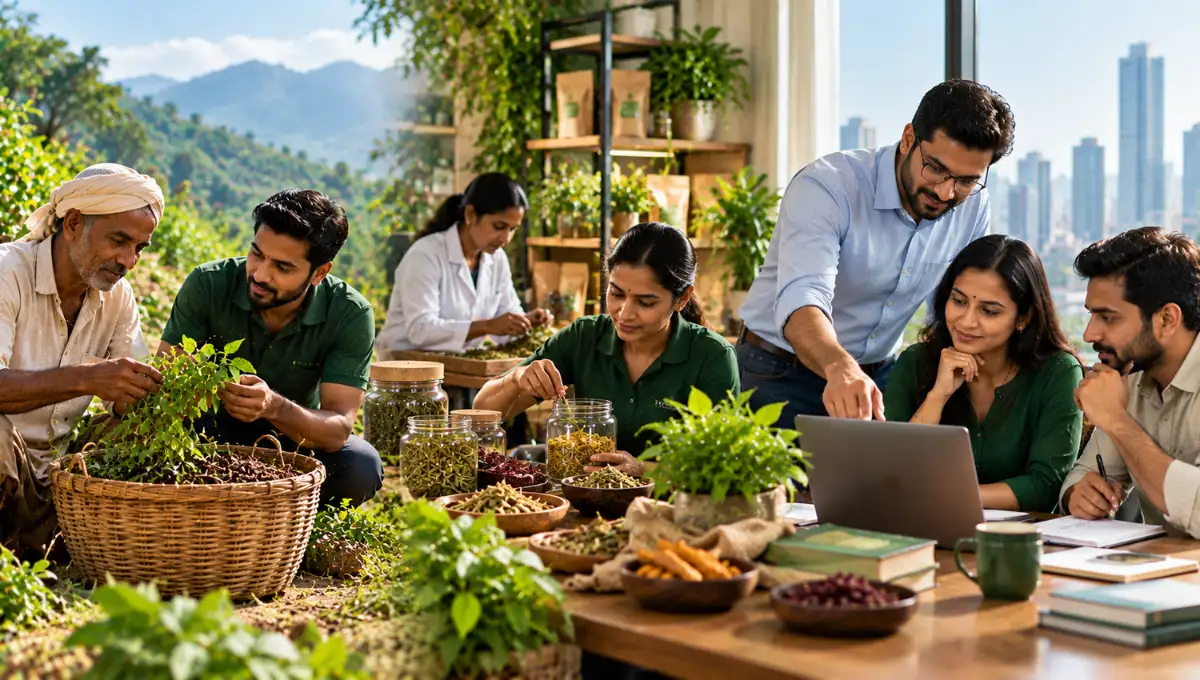

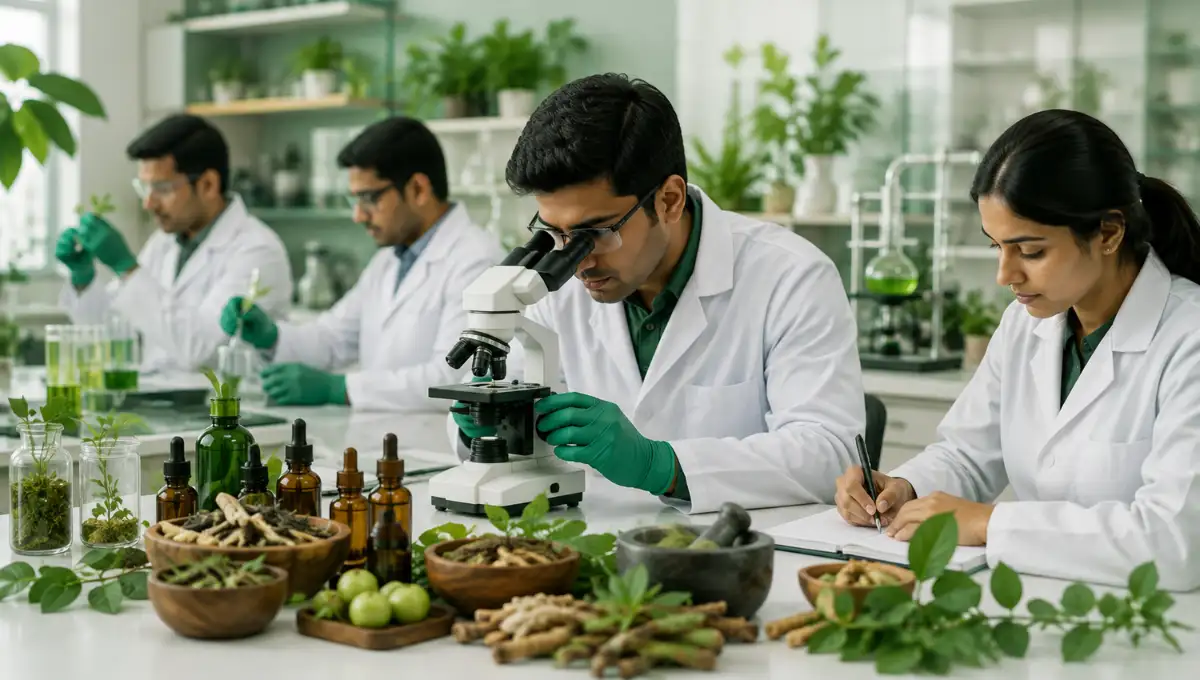
Learning from Tradition. Exploring with Science. Building for the Future.
Innovation begins with curiosity.
At Tanmatra Ventures Private Limited, research and innovation are part of how we understand ingredients, evaluate opportunities, improve products, strengthen processes, and respond to changing consumer expectations.
Our approach is particularly relevant to natural wellness and consumer products, where centuries of traditional knowledge exist alongside rapidly evolving scientific research, technology, manufacturing capabilities, and consumer behaviour.
We believe these worlds should not be treated as opposites.
Traditional knowledge can provide valuable direction. Modern research can help us investigate, understand, evaluate, and improve. Consumer insights can show where genuine needs exist. Technology can help turn knowledge into better products and experiences.
Our objective is not innovation for its own sake.
We seek practical innovation that can improve quality, relevance, transparency, convenience, sustainability, and consumer trust.
Our Approach to Research & Innovation
Curiosity with Purpose
Every meaningful innovation begins with a question.
Can a traditional ingredient be presented in a more convenient format?
Can sourcing be made more transparent?
Can a product be improved without unnecessary complexity?
Can better processing help preserve important characteristics of an ingredient?
Can packaging provide better protection while using resources more efficiently?
Can technology improve traceability or quality management?
Can consumer feedback reveal an unmet need?
At Tanmatra Ventures, we approach research as a continuous process of asking better questions and finding practical ways to answer them.
Our work is guided by four broad principles:
Understand deeply.
Evaluate carefully.
Develop responsibly.
Improve continuously.
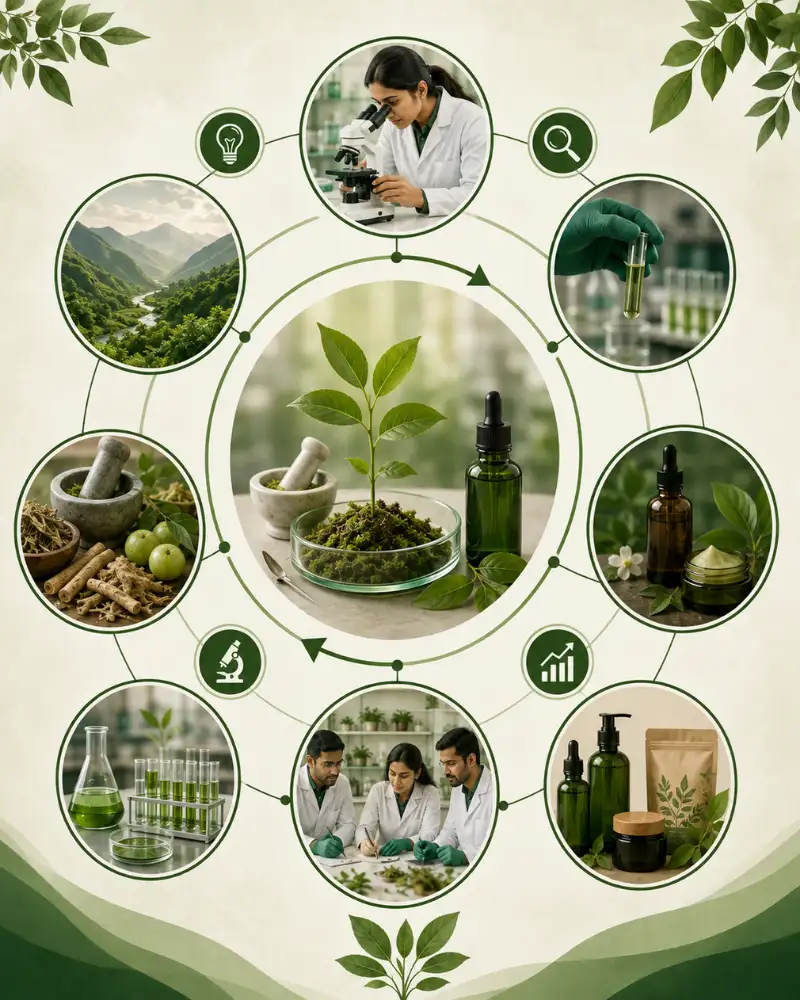
Tradition as a Starting Point
Learning from Generations of Knowledge
India has one of the world’s richest traditions of plant-based wellness.
Ayurveda and other traditional practices have developed extensive knowledge around herbs, roots, flowers, fruits, seeds, resins, oils, and other natural materials.
This knowledge represents an important starting point for exploration.
We seek to understand traditional ingredients within their historical and cultural context, including their established methods of preparation and use.
At the same time, we recognize an important distinction.
Traditional knowledge can guide exploration, but responsible modern product development also requires appropriate evaluation, quality systems, documentation, and regulatory awareness.
Our aim is to respect tradition without treating it as static.
Tradition Meets Modern Science
Exploring the Space Between Heritage and Evidence
One of the most interesting areas of natural wellness lies where traditional knowledge and contemporary scientific research meet.
Modern analytical techniques allow researchers to investigate botanical materials in ways that were not possible generations ago.
Researchers can examine:
- Botanical identity
- Chemical composition
- Naturally occurring compounds
- Physical characteristics
- Processing effects
- Stability
- Purity parameters
- Contaminants
- Standardization
- Potential biological activity
Scientific literature can also help us better understand what is known, what remains uncertain, and where further investigation may be valuable.
We believe responsible innovation requires respecting both knowledge and uncertainty.
Where evidence is evolving, communication should reflect that reality.
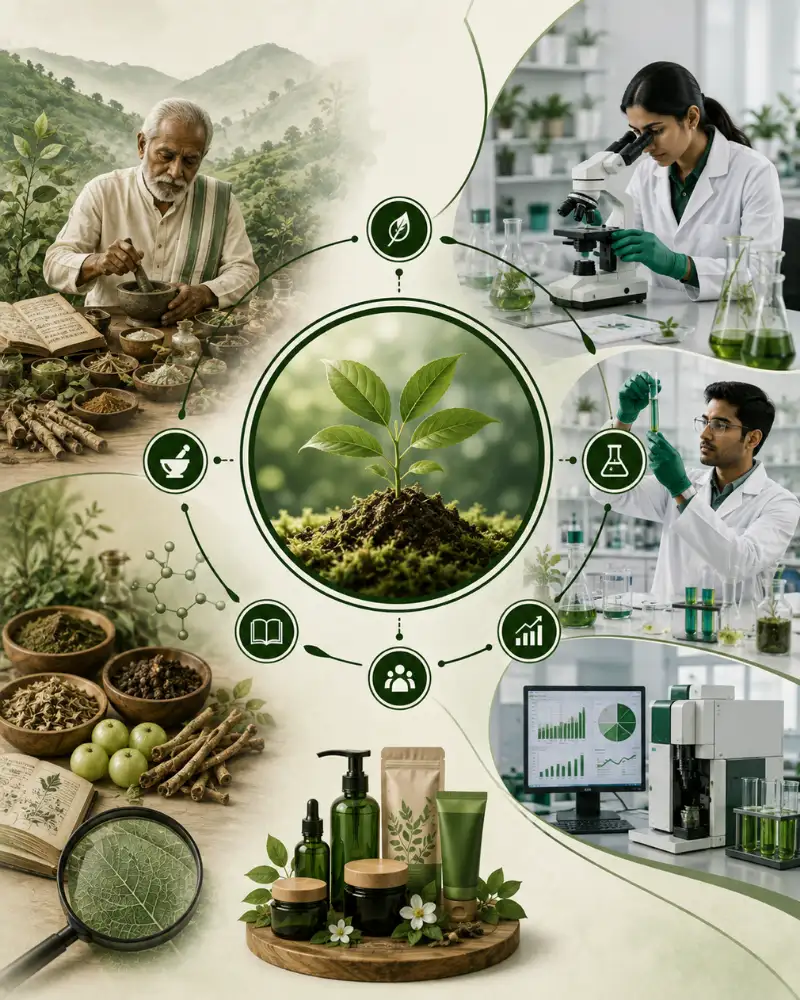
Understanding Natural Ingredients
Every Ingredient Has a Story
Natural ingredients are inherently complex.
The characteristics of a botanical material may vary according to:
Plant species
Geographic origin
Climate
Soil
Altitude
Growing conditions
Harvesting season
Plant part used
Harvesting method
Drying
Storage
Processing
Transportation
This variability makes ingredient understanding an important area of research.
For us, studying an ingredient means looking beyond its common name.
It means understanding where it comes from, how it is handled, what characteristics matter, how quality can vary, and how those variables may influence the finished product.
Better ingredient knowledge creates the foundation for better product decisions.
From Source to Research
Learning Begins Before the Laboratory
Research does not always begin with laboratory equipment.
Sometimes it begins in a field.
On a farm.
In a Himalayan village.
With a grower.
With a traditional practitioner.
With a sourcing partner.
Or by examining how a botanical material changes between harvesting and processing.
Field-level understanding can provide valuable context that laboratory data alone may not reveal.
For selected natural ingredients, we are interested in strengthening knowledge around:
Origin
Understanding where ingredients are sourced.
Cultivation and Collection
Learning how botanical materials are grown, harvested, or responsibly collected.
Post-Harvest Handling
Understanding drying, sorting, storage, and transportation.
Traditional Processing
Studying established methods where relevant.
Supply Chain Variability
Identifying factors that may influence consistency.
Connecting sourcing knowledge with analytical evaluation can provide a more complete understanding of natural materials.
Ingredient Authentication
Knowing What We Are Working With
One of the fundamental questions in natural product development is also one of the simplest:
Is the ingredient what it is supposed to be?
Botanical materials can sometimes present challenges related to species identification, substitution, adulteration, geographic variation, processing, or supply chain complexity.
Appropriate authentication and quality assessment can therefore play an important role in product development.
Depending on the ingredient and product category, evaluation may involve suitable physical, botanical, chemical, or analytical approaches.
The objective is straightforward.
Before building a product around an ingredient, we want to strengthen our understanding of that ingredient.
Research-Led Product Development
Turning Knowledge into Useful Products
Research becomes meaningful when it contributes to something useful.
Our product-development process seeks to connect several areas of knowledge:
Traditional Context + Scientific Understanding + Consumer Need + Quality + Practicality
The process may begin with an ingredient, consumer insight, market opportunity, or product idea.
From there, we explore questions such as:
What is the intended purpose of the product?
Who is it designed for?
What format is appropriate?
Which ingredients are relevant?
How should they be sourced?
What processing considerations matter?
What quality parameters should be evaluated?
How should the product be packaged?
How should consumers use it?
How can the product be communicated responsibly?
This helps move innovation from an interesting idea toward a practical consumer proposition.
Simplicity in Product Innovation
More Is Not Always Better
Innovation is sometimes associated with adding more.
More ingredients.
More features.
More claims.
More complexity.
We do not believe complexity automatically creates value.
In many cases, innovation may mean simplifying a product.
Improving ingredient selection.
Making instructions clearer.
Creating a more convenient format.
Improving packaging.
Removing unnecessary elements.
Strengthening quality controls.
Making sourcing easier to understand.
Or improving the customer experience.
Our preference is for purposeful innovation, where every meaningful change has a reason.
Exploring Product Formats
Making Natural Wellness Relevant to Modern Life
Traditional ingredients have historically been used in many different forms.
Modern consumers may have different expectations around convenience, portability, consistency, storage, preparation, and ease of use.
Research and product development can help bridge this gap.
Depending on the ingredient and intended use, we may explore formats such as:
- Traditional powders
- Capsules
- Oils
- Resins
- Botanical blends
- Concentrated formats
- Personal care applications
- Aromatic products
- Convenient everyday formats
- Emerging natural consumer products
The objective is not to modernize an ingredient simply for novelty.
The format should make the product more practical while respecting the characteristics of the ingredient.
Quality Research
Understanding What Quality Really Means
“High quality” is easy to say.
Understanding what quality means for a particular ingredient or product requires considerably more work.
Different product categories may require different quality considerations.
Research can help us identify appropriate parameters related to:
Identity
Purity
Physical characteristics
Composition
Microbiological quality
Contaminants
Stability
Packaging compatibility
Storage
Batch consistency
This knowledge can then contribute to product specifications, supplier expectations, testing strategies, documentation, and continuous improvement.
We view quality research as a practical bridge between product development and operational execution.
Testing & Analytical Thinking
Using Appropriate Evaluation to Support Better Decisions
Testing is an important part of many natural product quality systems, but a laboratory report alone does not define quality.
The right questions must first be asked.
What should be tested?
Why?
Which parameters are relevant?
What methods are appropriate?
How should results be interpreted?
How does the result connect with sourcing, manufacturing, storage, or product performance?
Our approach encourages analytical thinking throughout the product journey.
Testing should generate useful information that supports better decisions, not simply documentation.
Shilajit Research
Understanding a Complex Himalayan Material
Shilajit provides a useful example of why research and quality evaluation matter.
Unlike a simple manufactured ingredient, natural Shilajit is a complex material associated with particular mountainous environments and traditional purification practices.
Its characteristics can vary according to factors such as origin, collection, purification, processing, and storage.
Through the development of ACTIZEET® Himalayan Shilajit, we continue to deepen our understanding of areas including sourcing, purification, composition, quality parameters, authenticity, handling, packaging, and consumer education.
The category also illustrates a broader principle that guides our work:
The more complex a natural ingredient is, the more important it becomes to understand the journey behind the finished product.
Ayurvedic Botanical Research
Rediscovering Familiar Herbs with New Questions
Many Ayurvedic herbs have been known in Indian households for generations.
Ashwagandha.
Amla.
Brahmi.
Shatavari.
Triphala.
Tulsi.
Neem.
Moringa.
Haritaki.
Gokshura.
And many others.
Familiarity, however, does not mean there is nothing more to learn.
Research can explore botanical identity, sourcing regions, cultivation, harvesting, processing, composition, storage, stability, product formats, and evolving scientific literature.
This creates opportunities to look at familiar ingredients with fresh questions.
Traditional knowledge provides the heritage.
Research helps expand understanding.
Essential Oils & Botanical Aromatics
Exploring the Chemistry of Nature's Aromas
Essential oils represent another area where natural complexity meets modern analytical science.
Their aromatic profiles can be influenced by plant species, geography, climate, plant part, harvesting conditions, extraction method, storage, and age.
Research in this category may help strengthen understanding around:
Botanical identity
Extraction
Aromatic profile
Composition
Purity
Storage
Packaging
Stability
Appropriate usage
Consumer education
As with other natural products, responsible development requires both appreciation for the botanical source and attention to modern quality considerations.
Consumer Research
Innovation Starts with Real People
Not every research question belongs in a laboratory.
Some of the most valuable insights come directly from consumers.
What are people searching for?
What questions do they repeatedly ask?
Which products are difficult to understand?
What prevents them from purchasing?
What makes them trust one product over another?
Which formats are inconvenient?
What information is missing?
What do reviews reveal?
Where do customers need better guidance?
These questions can reveal opportunities for meaningful innovation.
Our digital-first businesses provide an important feedback loop between product teams and consumers.
We listen, learn, develop, observe, and improve.
Data-Informed Innovation
Turning Information into Better Decisions
Modern consumer businesses generate large amounts of information.
Search trends.
Website behaviour.
Product demand.
Customer queries.
Reviews.
Repeat purchases.
Returns.
Support interactions.
Inventory movement.
Content engagement.
When interpreted responsibly, this information can help reveal patterns that might otherwise remain hidden.
We use data as one input into decision-making.
It does not replace experience, judgment, creativity, or human understanding.
Instead, it can help us ask better questions and evaluate decisions more objectively.
Digital Research
Understanding How Consumers Discover and Learn
The way people research products is changing rapidly.
Traditional search engines remain important, but consumers increasingly discover information through marketplaces, social platforms, video, communities, conversational interfaces, and AI-powered systems.
This evolution creates a new area of research for consumer brands.
We are interested in understanding how information can be structured so that it remains:
Accurate.
Accessible.
Useful.
Understandable.
Discoverable.
Consistent.
As digital discovery evolves, brands will need to think beyond conventional advertising and focus increasingly on the quality of their underlying information.
Technology as an Innovation Enabler
Better Systems Can Create Better Products
Innovation is not limited to what consumers see.
Some of the most valuable improvements happen behind the scenes.
Technology can help strengthen:
- Supplier information
- Quality documentation
- Inventory planning
- Traceability
- Product data
- Consumer support
- Demand forecasting
- Content management
- Performance analysis
- Workflow automation
- Decision-making
We are interested in applying technology where it improves clarity, efficiency, responsiveness, or accountability.
Technology should serve the business purpose.
Not the other way around.
Artificial Intelligence
Exploring New Tools Responsibly
Artificial intelligence is changing how companies research, analyze information, create content, understand customers, manage knowledge, and operate digital businesses.
We see AI as an emerging capability with significant potential.
Possible applications may include:
Research assistance
Knowledge organization
Data analysis
Consumer insight discovery
Content workflows
Customer service support
Product information management
Forecasting
Operational automation
Internal decision support
At the same time, AI-generated outputs require appropriate human oversight, especially where accuracy, health information, product claims, regulatory requirements, or consumer trust are involved.
Our approach is therefore exploratory but responsible.
Use technology to enhance human judgment, not eliminate it.
Packaging Innovation
Protecting Products with Greater Efficiency
Packaging is an important area for research and improvement.
For natural products, packaging may need to protect against factors such as moisture, light, air, contamination, leakage, or physical damage.
At the same time, consumers and businesses increasingly expect packaging to use resources more responsibly.
This creates a continuing design challenge:
How can we protect the product effectively while reducing unnecessary environmental impact?
Areas for exploration may include:
Material efficiency
Pack sizing
Recyclability
Reusable formats
Reduced secondary packaging
Lightweight materials
Product protection
Transportation efficiency
Label clarity
Consumer convenience
There may not always be a perfect solution.
But there is usually an opportunity to improve.
Sustainability Through Innovation
Doing More with Greater Awareness
Innovation can also help address environmental challenges.
Natural product businesses depend on agriculture, biodiversity, water, land, energy, packaging materials, and transportation.
Sustainability therefore cannot be separated completely from innovation.
Research may help identify opportunities related to:
Responsible Ingredient Sourcing
Understanding how natural materials are produced and collected.
Resource Efficiency
Reducing unnecessary use of materials, energy, or processes.
Waste Reduction
Finding ways to minimize avoidable waste.
Packaging
Exploring more efficient material choices and formats.
Supply Chains
Improving planning and reducing unnecessary movement.
Circular Thinking
Exploring how materials may remain useful for longer.
Progress will require experimentation, learning, partnerships, and realistic evaluation.
Collaboration
Better Questions Often Need Different Expertise
Research and innovation rarely happen in isolation.
Natural consumer products can involve knowledge from many fields.
Botany.
Ayurveda.
Agriculture.
Chemistry.
Food science.
Pharmacognosy.
Manufacturing.
Packaging.
Design.
Technology.
Data science.
Consumer research.
Sustainability.
Regulation.
This makes collaboration important.
Depending on the project, we may work with or learn from:
Farmers and growers
Traditional knowledge holders
Ingredient specialists
Laboratories
Researchers
Academic institutions
Manufacturers
Packaging specialists
Technology partners
Consultants
Consumer communities
Different perspectives can help identify questions and solutions that one discipline alone may miss.
Working with Research Institutions
Connecting Industry with Knowledge
India has a growing ecosystem of universities, laboratories, research institutions, agricultural organizations, startups, and technical specialists.
We see opportunities for responsible collaboration between industry and these knowledge networks.
Such collaboration may support areas including:
- Ingredient characterization
- Botanical research
- Quality evaluation
- Product development
- Analytical methods
- Processing
- Packaging
- Sustainability
- Agricultural practices
- Consumer research
- Emerging technologies
Our long-term objective is to strengthen the bridge between useful research and practical consumer applications.
Innovation Through Partnerships
We Do Not Need to Invent Everything Ourselves
Innovation can come from many places.
A farmer may discover a better cultivation practice.
A packaging supplier may introduce a more efficient material.
A laboratory may develop a useful analytical method.
A technology company may improve traceability.
A researcher may identify a promising area for investigation.
A customer may reveal a problem no one inside the company noticed.
Our role is not necessarily to create every idea internally.
It is to build the ability to recognize, evaluate, adapt, and responsibly scale useful ideas.
Responsible Innovation
Progress Without Losing Perspective
Innovation can create excitement.
It can also create pressure to move too quickly.
In wellness and natural consumer products, responsible innovation requires particular care.
New ideas should be considered alongside:
- Consumer safety
- Product quality
- Scientific evidence
- Traditional context
- Regulatory requirements
- Environmental impact
- Supply chain implications
- Communication
- Long-term trust
A new product is not automatically a better product.
A new technology is not automatically the right technology.
A new claim is not automatically a responsible claim.
We believe innovation should be evaluated by the value it creates, not simply by its novelty.
Research and Responsible Communication
Understanding the Difference Between Evidence and Marketing
Scientific research can be complex.
One study does not always provide a definitive conclusion.
Laboratory research is not necessarily equivalent to demonstrated outcomes in people.
Traditional use is not the same as clinical evidence.
Emerging findings should not be presented as established facts.
These distinctions matter.
We encourage responsible interpretation of research and careful translation of technical information into consumer communication.
The objective should be to help people understand products, not overwhelm them with scientific terminology or create unrealistic expectations.
Credibility grows when brands communicate both what is known and what remains uncertain.
Innovation at ACTIZEET®
Turning Learning into Everyday Improvement
Our flagship wellness brand, ACTIZEET®, provides a practical environment in which research and innovation can be applied.
Learning from sourcing, product development, quality evaluation, customer questions, digital behaviour, packaging, and market feedback can help us continuously improve the brand.
Innovation does not always result in a completely new product.
Sometimes it means:
Improving an existing product.
Strengthening a specification.
Finding a better supplier.
Improving packaging.
Making instructions clearer.
Creating better educational content.
Enhancing digital discovery.
Improving customer support.
Reducing unnecessary complexity.
These incremental improvements can collectively create significant long-term value.
Building an Innovation Culture
Curiosity Should Exist Across the Organization
Research and innovation should not belong to a single department.
People working in sourcing may identify opportunities.
Quality teams may notice patterns.
Customer support may discover recurring problems.
Marketing may identify changing consumer questions.
Operations may find inefficient processes.
Technology teams may discover opportunities for automation.
Leadership may identify new markets or capabilities.
We want to encourage a culture where people are comfortable asking:
Why do we do it this way?
Can we understand this better?
Can we simplify it?
Can we improve it?
Is there a better solution?
A culture of continuous questioning can create continuous improvement.
From Idea to Innovation
A Disciplined Development Process
Ideas are abundant.
Successful innovation requires discipline.
Our evolving approach can be represented through a simple process:
Discover
Identify consumer needs, ingredient opportunities, technological changes, operational challenges, or emerging market possibilities.
Research
Study the available knowledge, consumer context, supply chain, scientific literature, competitive environment, and regulatory considerations.
Evaluate
Determine whether the opportunity fits our capabilities, values, quality expectations, and long-term strategy.
Develop
Create concepts, prototypes, processes, packaging, or digital solutions.
Test
Evaluate relevant quality, usability, operational, commercial, or consumer considerations.
Learn
Study results and identify weaknesses or opportunities.
Improve
Refine the solution.
Scale Responsibly
Expand only when the foundations are capable of supporting growth.
This process helps us distinguish between an interesting idea and a useful innovation.
Research for Future Categories
Looking Beyond Today's Portfolio
Our current experience is concentrated around natural wellness and consumer products.
But the capabilities developed through research can have broader applications.
Over time, we may explore opportunities across areas such as:
- Botanical wellness
- Ayurvedic ingredients
- Natural personal care
- Botanical beauty
- Aromatic wellness
- Functional natural products
- Sustainable packaging
- Digital wellness education
- Supply chain technology
- Traceability
- Consumer intelligence
- Emerging natural product categories
Exploration does not mean immediate commercialization.
Some ideas may become products.
Some may improve existing processes.
Some may lead to partnerships.
And some may simply teach us something useful.
Research creates options.
From India to the World
Researching Indian Knowledge for Global Relevance
India possesses extraordinary natural and intellectual resources.
Traditional wellness knowledge.
Botanical diversity.
Agricultural ecosystems.
Scientific institutions.
Technical talent.
Manufacturing capabilities.
Digital expertise.
Entrepreneurship.
We believe there is significant potential to connect these strengths more effectively.
The opportunity is not simply to export traditional ingredients.
It is to build deeper knowledge around them.
Strengthen quality.
Improve documentation.
Develop appropriate formats.
Communicate responsibly.
Use modern technology.
And build trusted Indian brands capable of serving global consumers.
Research and innovation can help create that bridge.
Our Long-Term Research Vision
Building Knowledge That Compounds Over Time
Individual projects may end.
Knowledge should continue accumulating.
Our long-term ambition is to build an organizational knowledge base around the ingredients, categories, consumers, technologies, and supply chains relevant to our businesses.
Every sourcing visit can teach us something.
Every laboratory evaluation can add information.
Every product launch can generate insight.
Every customer question can reveal a knowledge gap.
Every failure can improve the next decision.
Every collaboration can expand our perspective.
Over time, these learnings can become a valuable organizational capability.
Knowledge compounds when an organization learns deliberately.
The Future We Are Exploring
Tradition. Science. Technology. Consumer Insight.
The future of natural consumer products will likely be shaped by the convergence of several forces.
Consumers will become better informed.
Ingredient traceability will become increasingly important.
Scientific research will continue expanding.
Artificial intelligence will change information discovery.
Digital commerce will connect brands directly with consumers.
Quality expectations will rise.
Sustainability will become more important.
Traditional knowledge will continue attracting global interest.
The companies best prepared for this future will not necessarily be those that predict every change correctly.
They will be those capable of learning and adapting.
That is the capability we are building.
Our Research & Innovation Commitment
Learn. Question. Test. Improve.
At Tanmatra Ventures Private Limited, research and innovation are ultimately about becoming better at what we do.
Better at understanding ingredients.
Better at understanding consumers.
Better at developing products.
Better at evaluating quality.
Better at sourcing responsibly.
Better at communicating knowledge.
Better at using technology.
Better at reducing unnecessary complexity.
Better at recognizing opportunities.
And better at learning from experience.
We do not expect every question to have an immediate answer.
But we believe organizations that continue asking meaningful questions create better possibilities for the future.
Respect tradition.
Explore evidence.
Embrace useful technology.
Listen to consumers.
Keep learning.
Keep improving.
Let's Explore What Comes Next
Research becomes more valuable when knowledge is shared and complementary expertise comes together.
Tanmatra Ventures welcomes conversations with researchers, academic institutions, laboratories, botanical experts, agricultural organizations, ingredient specialists, manufacturers, packaging innovators, technology companies, startups, and other organizations interested in responsible innovation across natural wellness and consumer products.
Together, we can explore how India’s traditional knowledge, natural resources, scientific capabilities, and entrepreneurial energy can contribute to the next generation of trusted consumer products.
Explore Our Wellness & Ayurveda Business