

Medicinal Plant Farming · Ayurveda · Rural Livelihoods
Why Farmers Matter to the Future of Natural Wellness
Every ambitious growth projection for India's natural wellness industry, every export target, every new product line, ultimately depends on a single, unglamorous constraint: someone has to actually grow the plants. Ashwagandha does not appear on a shelf because a brand wills it into existence. It exists because a farmer decided to plant it, tended it through a full growing season, and harvested it at the right time, often taking on real financial risk to do so. As India's AYUSH and natural wellness industry pursues genuinely enormous growth ambitions in the years ahead, the farmers who cultivate the raw botanical material this entire industry depends on deserve far more attention, and far more fair partnership, than they typically receive.
- Farmers Are the Actual Bottleneck on Industry Growth
- Why Farmers Have Historically Hesitated to Grow Medicinal Plants
- How Government Policy Is Trying to Change This Calculation
- Contract Farming: A Genuinely Different Way to Share Risk
- Why Quality Genuinely Starts With the Farmer, Not the Factory
- The Generational Knowledge Problem Nobody Is Solving Fast Enough
- What Fair Partnership With Farmers Should Actually Look Like
- Frequently Asked Questions
- Final Word
Farmers Are the Actual Bottleneck on Industry Growth
India's AYUSH and natural wellness industry is currently projected to grow from roughly 43 billion US dollars in 2024 to as much as 200 billion dollars by 2030, an eightfold expansion within a single decade, according to industry analysis compiled by the India Brand Equity Foundation. Numbers this large tend to draw attention toward the brands, the export deals, and the consumer demand driving them, but every single one of these figures depends entirely on a supply-side capacity that receives far less attention: enough farmers, growing enough medicinal plants, on enough cultivated land, to actually supply raw material at this scale.
This is not a minor operational detail. Research on medicinal plant cultivation in India has repeatedly identified inadequate raw material supply as a genuine constraint on the industry's growth potential, since demand for many high-value medicinal plants has historically outpaced what organized cultivation could reliably supply, pushing continued reliance on wild collection even for species where wild harvesting carries documented sustainability concerns. An industry planning for eightfold growth cannot responsibly plan around wild collection alone. It needs many more farmers choosing to grow medicinal plants deliberately, which means understanding why farmers have historically been reluctant to do so, and what would actually change that calculation.
Why Farmers Have Historically Hesitated to Grow Medicinal Plants
Medicinal plant cultivation carries a genuinely different risk profile than staple food crops, and this difference explains much of the historical hesitation. Unlike wheat, rice, or common vegetables, medicinal plants often have thinner, more specialized buyer networks, meaning a farmer who commits an entire growing season to a crop like ashwagandha or shatavari faces real uncertainty about whether a reliable buyer will actually be available at harvest time, and at what price. Research on India's herbal industry has specifically noted that the sector has historically procured medicinal plants through a fragmented network of traders and collectors, a supply structure that offers farmers little price predictability or long-term security compared to established food crop markets with government-backed minimum support prices.
This uncertainty is compounded by the specialized agronomic knowledge many medicinal plants require, correct harvest timing, specific soil and climate needs, and appropriate post-harvest handling that differs meaningfully from conventional crop farming. A farmer without established buyer relationships, reliable market information, or technical training in these specific requirements faces a genuinely riskier proposition than continuing with familiar staple crops, even when medicinal plant cultivation could, in principle, be significantly more profitable per acre.
How Government Policy Is Trying to Change This Calculation
India's government has recognized this exact bottleneck and built substantial policy infrastructure specifically to address it. The National Medicinal Plants Board, established under the Ministry of AYUSH in 2000, runs a Central Sector Scheme that provides direct cultivation subsidies to farmers, ranging from 30 percent for common therapeutic species up to 75 percent for highly endangered or critically declining medicinal plants, covering a prioritized list of 140 species that includes widely used botanicals like ashwagandha, tulsi, shatavari, and brahmi.
The scheme's structure specifically reflects an understanding of the risk-sharing problem discussed above. Financial assistance is shared between central and state governments, with a notably higher 90:10 ratio specifically for farmers in North Eastern and hilly states, regions with significant medicinal plant biodiversity but historically limited agricultural infrastructure investment. Beyond direct cultivation subsidies, the scheme's broader components include support for establishing nurseries with quality planting material, post-harvest management infrastructure, and primary processing and marketing support, addressing multiple points along the risk chain that has historically discouraged farmers from entering this specific crop category.
Contract Farming: A Genuinely Different Way to Share Risk
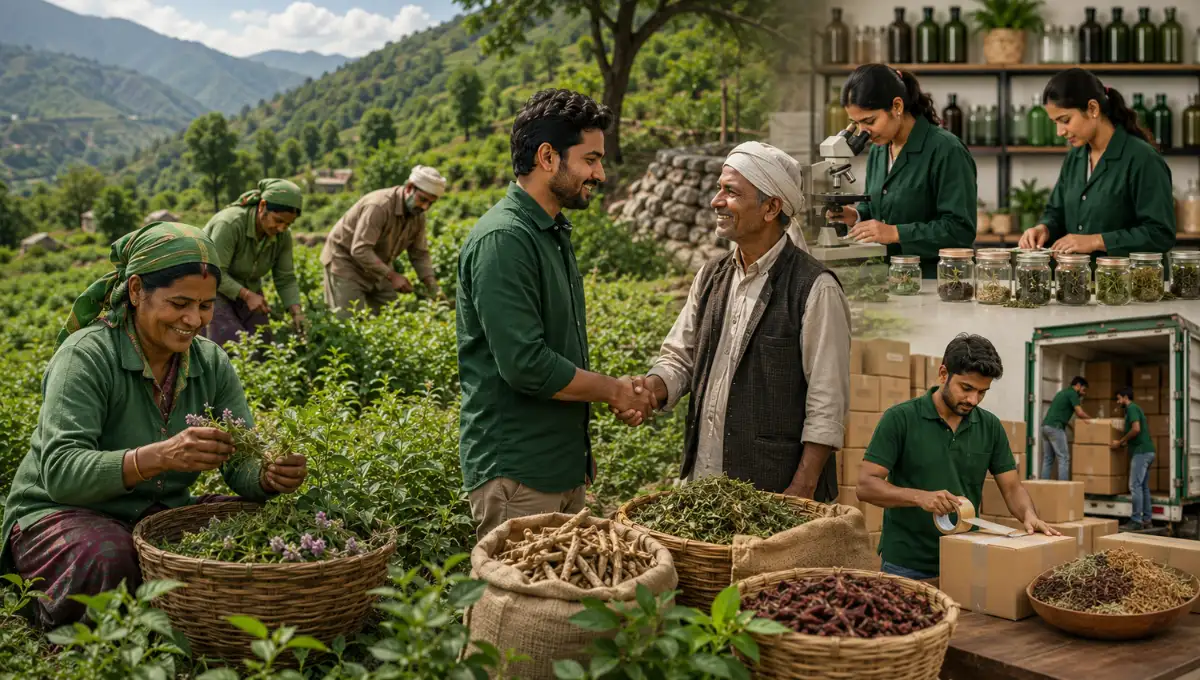
Perhaps the most structurally important element of India's medicinal plant policy framework is its explicit support for contract farming arrangements, and understanding why this model matters requires understanding what it actually changes for a farmer's decision-making. Under this approach, AYUSH industry buyers, extract manufacturers, and exporters enter into buy-back agreements directly with farmers or farmer clusters, agreeing in advance on both price and volume before the growing season even begins, with the cost of cultivation shared between the industry partner and the farmer on mutually agreed terms.
This structure directly addresses the core risk that has historically discouraged medicinal plant cultivation: uncertainty about whether a buyer will actually exist at harvest time and what price they will offer. Research specifically examining contract farming arrangements for medicinal plants in India has noted that this model allows farmers to raise income from medicinal plant cultivation more reliably than through traditional commercial crops, precisely because the buy-back agreement removes the market uncertainty that otherwise makes this category of farming feel too risky compared to established staple crops. India's National Bank for Agriculture and Rural Development has separately developed a dedicated refinance package specifically to support contract farming arrangements in the agriculture sector, reflecting institutional recognition that this financing structure deserves specific support rather than being left purely to informal private negotiation between individual farmers and buyers.
Why Quality Genuinely Starts With the Farmer, Not the Factory
It is worth being direct about why farmer relationships matter for something beyond fair economics alone: the actual quality of a finished botanical product is substantially determined by decisions the farmer makes months before any processing facility ever touches the raw material. Appropriate seed selection, correct planting density, proper soil preparation, and precise harvest timing all directly affect a plant's eventual active compound concentration, decisions no amount of downstream processing sophistication can fully correct for after the fact.
This is precisely why the closer and more direct a company's relationship with its farming partners, the more genuine influence and visibility it has over exactly these quality-determining decisions. A company purchasing anonymous bulk material through several layers of traders has essentially no ability to influence, or even fully know, what happened at the field level. A company with a direct, ongoing relationship with specific farmers, ideally supported by agronomic training and appropriate harvest timing guidance, is positioned to genuinely improve raw material quality at its actual source, rather than trying to compensate for inconsistent raw material through processing and testing alone.
The Generational Knowledge Problem Nobody Is Solving Fast Enough
Beyond the immediate economic questions, there is a slower-moving but genuinely serious risk to the industry's long-term future: the specialized agronomic knowledge required to grow many medicinal plants well is concentrated in an aging farming population, and the economic uncertainty discussed throughout this article is a direct reason younger farmers have been reluctant to take up medicinal plant cultivation as a primary livelihood. This mirrors a pattern documented among wild plant collector communities as well, where field research has found that older generations hold significantly more specialized botanical knowledge than younger community members, who face economic pressure toward other forms of work instead.
This generational transition risk is precisely why the government schemes and contract farming models discussed above matter beyond their immediate economic function. By making medicinal plant cultivation genuinely more financially secure and predictable, these mechanisms create the conditions under which younger farmers might reasonably choose to learn and continue this specialized cultivation knowledge, rather than watching it fade as an older generation of medicinal plant farmers ages out of active farming with no clear successor trained to take their place.
What Fair Partnership With Farmers Should Actually Look Like
Given everything above, here is what a natural wellness company genuinely committed to its farming partners should actually be doing.
Direct, Multi-Season Relationships Rather Than One-Off Purchases
Companies that commit to ongoing, multi-year relationships with specific farming partners give those farmers the confidence to invest in proper cultivation practices, knowing a buyer relationship will continue beyond a single harvest.
Pre-Agreed Pricing and Volume Commitments
Following the contract farming model that government policy actively supports, agreeing on price and volume before the growing season begins removes the single largest source of financial risk that has historically discouraged farmers from entering medicinal plant cultivation.
Agronomic Training and Technical Support
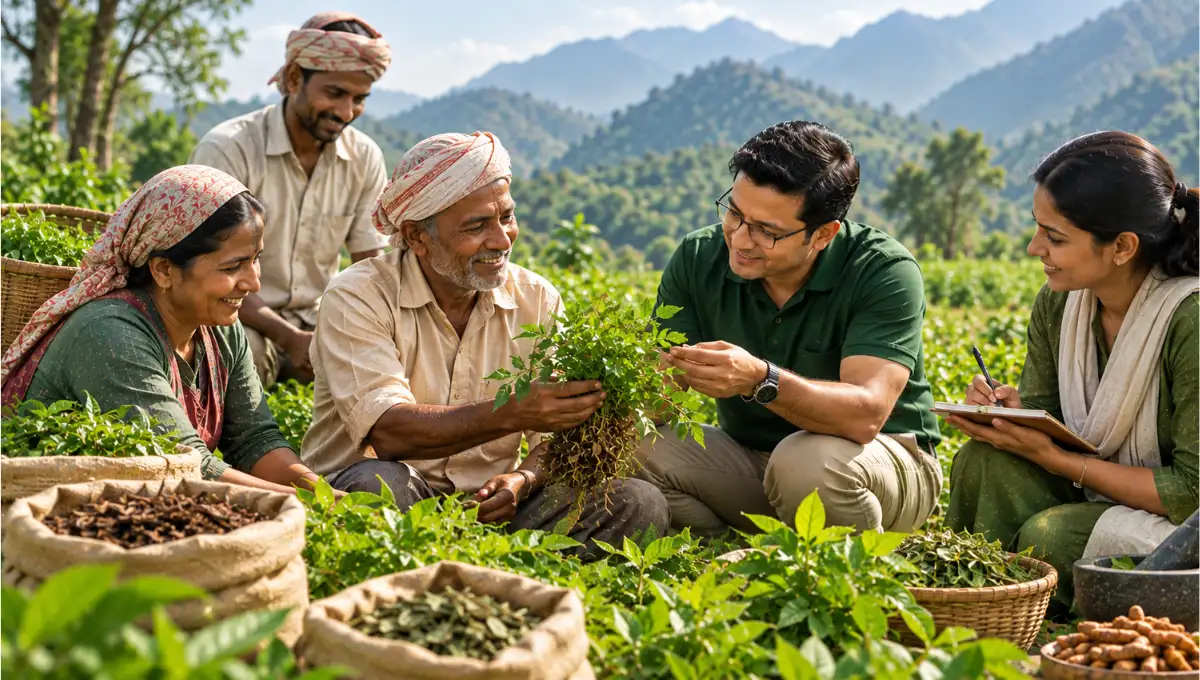
Given how directly field-level decisions determine finished product quality, companies benefit directly from investing in farmer training on correct cultivation, harvest timing, and post-harvest handling specific to the botanicals they are sourcing.
Helping Farmers Access Available Government Subsidy Programs
Given how substantial NMPB's cultivation subsidies genuinely are, companies can add real value simply by helping their farming partners navigate and access these existing support programs rather than leaving farmers to discover and apply for them alone.
Transparent Communication With the End Consumer
Brands willing to actually name and describe their farming partnerships give consumers genuine insight into the human relationships behind their products, rather than leaving this entire dimension invisible behind a finished, packaged label.
This is precisely the kind of farmer partnership that responsible Ayurvedic wellness brands need to be building as this industry pursues the ambitious growth ahead of it. ACTIZEET® is one example of a brand within this category treating direct farmer relationships as a genuine operational priority, recognizing that the eightfold growth the industry is projecting cannot actually happen without a corresponding investment in the farmers whose fields will need to supply it, and that a brand's long-term reliability depends entirely on the reliability of the partnerships it maintains at the very start of its supply chain.
Frequently Asked Questions
Yes. The National Medicinal Plants Board, under the Ministry of AYUSH, runs a Central Sector Scheme providing cultivation subsidies of 30, 50, or 75 percent of cost depending on the specific plant's conservation status, covering a prioritized list of 140 medicinal plant species including ashwagandha, tulsi, shatavari, and brahmi. Financial assistance is shared between central and state governments, with a more favorable 90:10 ratio specifically for farmers in North Eastern and hilly states.
Contract farming involves AYUSH industry buyers, exporters, and manufacturers agreeing in advance with farmers on both price and volume before the growing season begins, with cultivation costs shared between the parties. This model directly addresses the market uncertainty that has historically discouraged farmers from growing medicinal plants, since it removes the risk of investing an entire season into a crop with no guaranteed buyer or price at harvest time. India's National Bank for Agriculture and Rural Development has developed a dedicated refinance package specifically supporting this arrangement.
Medicinal plants have historically had thinner, less predictable buyer networks compared to staple food crops with established government-backed minimum support prices. Research on India's herbal industry has noted the sector has traditionally relied on fragmented trader and collector networks rather than reliable, direct buyer relationships, leaving farmers uncertain about price and demand at harvest time, a risk that discourages farmers from committing an entire growing season to these specialized crops.
This remains a genuine open question and a real constraint on the industry's ambitions. With India's AYUSH industry projected to grow roughly eightfold by 2030, meeting this demand sustainably requires substantially more organized cultivation rather than continued reliance on wild collection alone. Government schemes supporting farmer subsidies and contract farming are specifically designed to expand cultivated supply, but whether farmer participation grows fast enough to match projected industry demand is a genuine, ongoing challenge for the sector.
Final Word: No Farmers, No Future
Every projection, every export target, and every new product line in India's rapidly growing natural wellness industry rests on a foundation that receives far less attention than it deserves: the individual decision of a farmer, somewhere in a specific field, to plant ashwagandha or shatavari instead of a more familiar, lower-risk crop. That decision depends on whether the economics genuinely make sense, whether a reliable buyer actually exists at harvest time, and whether the knowledge required to grow these specialized plants well continues to be passed down to a new generation willing to learn it. An industry planning for eightfold growth over the next decade cannot treat this foundation as someone else's problem to solve. The brands and policies that take farmer partnership seriously now, through fair contracts, genuine training, and real economic security, are the ones actually building the supply this ambitious future will require, rather than simply hoping it appears on its own.