

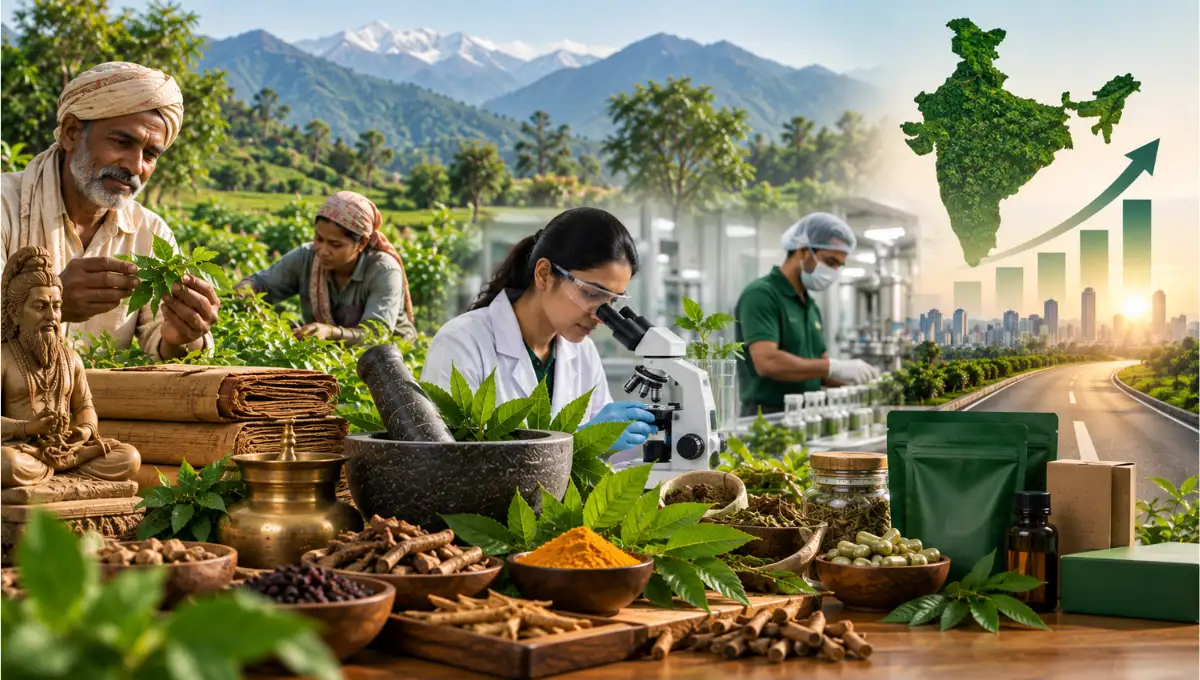

Ayurveda · AYUSH Industry · India 2026
India's Ayurveda Industry: Opportunities, Challenges and the Road Ahead
India's Ayurveda industry sits at a genuinely unusual moment in its long history. It has the growth numbers, the government backing, and the global consumer interest to become one of the world's defining natural health sectors. It also has real, well-documented structural weaknesses, in quality standardization, regulatory harmonization, and international workforce presence, that stand between the industry's current position and the much larger future being projected for it. A recent NITI Aayog and PwC roadmap has gone as far as proposing Ayurveda as a pillar of global healthcare by 2047, India's centenary of independence. Getting there requires an honest look at both sides of this picture, not just the optimistic growth projections that dominate most industry coverage.
- The Scale of the Opportunity in Front of India
- Challenge One: Supply Chain Quality Is the Industry's Weakest Link
- Challenge Two: Global Regulatory Barriers Are Real, Not Theoretical
- Challenge Three: A Practitioner Workforce That Rarely Leaves India
- The Uncomfortable Comparison With Traditional Chinese Medicine
- The Genuine Tension Between Standardization and Tradition
- The Road Ahead: What Actually Needs to Happen
- Frequently Asked Questions
- Final Word
The Scale of the Opportunity in Front of India
The growth numbers behind India's Ayurveda and broader AYUSH industry are genuinely difficult to overstate. Industry analysis compiled by the India Brand Equity Foundation projects the sector growing from roughly 43 billion US dollars in 2024 to as much as 200 billion dollars by 2030, an eightfold expansion within a single decade. Export performance has already demonstrated real momentum behind this ambition: Ayurvedic product exports have doubled from 1.09 billion US dollars in 2014 to 2.16 billion dollars in 2023, now reaching around 150 countries worldwide, according to a recent NITI Aayog and PwC strategic roadmap examining Ayurveda's global potential.
That same roadmap makes a genuinely bold claim worth taking seriously: with the right combination of scientific validation, regulatory alignment, and credible global branding, India could build Ayurveda into a 500 billion dollar global industry, creating millions of skilled jobs and establishing genuine international leadership in natural medicine, according to analysis published through PolicyCircle drawing on this research. This is not a small or symbolic ambition. It represents a vision of Ayurveda functioning as a genuine pillar of global healthcare, not simply a wellness curiosity confined to a niche international audience, and India's own government has formally adopted 2047, the year marking a century of independence, as the target horizon for this transformation.
Challenge One: Supply Chain Quality Is the Industry's Weakest Link
Ambitious growth projections mean little if the underlying supply chain cannot support them, and this is precisely where independent analysis has been most direct. Industry commentary examining Ayurveda's path to becoming a genuinely massive global industry has described supply chain quality plainly as the weakest link in the entire value chain, noting that even with strong clinical research validating specific ingredients, India faces well-documented and persistent challenges including adulteration, inconsistent phytochemical content between batches, and pesticide residue contamination, problems that climate variability has further compounded by disrupting the reliable availability of key medicinal plants.
Peer-reviewed research examining standardization demands across India's herbal medicine industry has reached remarkably similar conclusions, noting that commercial formulations often fail to consistently match established Indian Pharmacopoeia monographs, and that adulteration involving non-standard plant parts or synthetic compound spiking further complicates efforts to verify product authenticity. The same research found that voluntary quality certification systems, including the Ayush Premium Mark and the Quality Council of India's GMP compliance scheme, have genuinely improved export credibility where adopted, but uptake among small and medium-scale manufacturers remains limited due to certification cost, limited awareness, and technical barriers to implementation, meaning the industry's quality baseline remains genuinely inconsistent across its full range of producers rather than uniformly high.
Challenge Two: Global Regulatory Barriers Are Real, Not Theoretical
Beyond domestic quality challenges, India's Ayurveda export ambitions run directly into a fragmented and genuinely restrictive international regulatory landscape. In the United States, most Ayurvedic products are classified under the Dietary Supplement Health and Education Act, which limits the therapeutic claims a product can legally make and requires meaningful compliance investment. The European Union's regulatory position is considerably more restrictive still: its Traditional Herbal Medicinal Products Directive requires 30 years of documented traditional use, including at least 15 years specifically within the EU, a requirement that functions as an effective non-tariff barrier keeping the large majority of Indian Ayurvedic products out of the European market entirely, regardless of their actual quality or traditional pedigree in India itself.
This regulatory fragmentation has a direct, measurable consequence on how India's exports are actually classified and perceived internationally. The NITI Aayog and PwC roadmap notes that despite genuine export growth, most Ayurvedic products abroad are categorized as dietary supplements rather than medicines, a classification that reflects these regulatory barriers directly and limits how seriously Ayurveda is treated within mainstream international healthcare systems, insurance coverage for Ayurvedic services remains rare outside India entirely, and integration into formal healthcare frameworks abroad has been correspondingly slow despite genuinely growing consumer interest.
Challenge Three: A Practitioner Workforce That Rarely Leaves India
India has built a genuinely substantial domestic Ayurvedic practitioner base, with the NITI Aayog and PwC roadmap documenting over 355,000 trained Ayurvedic practitioners currently active. The challenge is that this workforce is overwhelmingly concentrated within India itself, with 95 percent of trained practitioners remaining in the country, leaving a genuinely limited pool of qualified Ayurvedic professionals available internationally to support clinical practice, education, and credibility-building in the very markets India hopes to expand into.
This workforce concentration problem compounds the regulatory challenges discussed above in a specific and important way: even where a country's regulatory system might permit Ayurvedic practice or product sales, a genuine shortage of internationally practicing, credentialed Ayurvedic practitioners limits the clinical infrastructure needed to build the kind of sustained, professionally credible presence that would support deeper mainstream healthcare integration abroad, rather than Ayurveda remaining confined largely to wellness tourism and consumer product sales.
The Uncomfortable Comparison With Traditional Chinese Medicine
India's own strategic planning documents do not shy away from a genuinely uncomfortable comparison worth taking seriously. The NITI Aayog and PwC roadmap draws a direct contrast between Ayurveda's current global position and Traditional Chinese Medicine's considerably greater international penetration, attributing TCM's success specifically to mission-scale state support, deep and sustained research and development funding, and proactive diplomatic promotion carried out systematically over decades. China has reportedly established more than 30 overseas TCM centres, integrated TCM provisions directly into its free trade agreements, and secured formal recognition through International Organization for Standardization standards, a level of coordinated, sustained international institution-building that Ayurveda has not yet matched.
This comparison is genuinely instructive rather than simply discouraging, because it identifies specific, replicable mechanisms rather than vague cultural advantages. India's roadmap explicitly recommends adopting comparable strategies: establishing dedicated Ayurveda hubs internationally, developing Ayush Visa packages to support medical tourism, and pursuing more proactive diplomatic promotion of Ayurveda through trade and cultural channels, treating TCM's success as a genuine template to learn from rather than an unmatched advantage unique to China's specific circumstances.
The Genuine Tension Between Standardization and Tradition
It would be incomplete to present standardization purely as an unambiguous solution, because scholarly analysis of Ayurveda's globalization has identified a genuine tension worth acknowledging honestly. Academic research examining Ayurveda's path toward international standardization has noted that the push for uniformity, while genuinely necessary for global regulatory recognition, risks marginalizing smaller practitioners and regional manufacturers who lack the resources to meet increasingly stringent compliance standards, potentially concentrating the benefits of global expansion disproportionately among large, well-capitalized pharmaceutical companies while sidelining the grassroots diversity that has historically sustained Ayurvedic practice across India's many regional traditions.
This tension does not have an easy resolution, but it does clarify what a genuinely thoughtful path forward requires: standardization sufficient to support international regulatory credibility and consistent product quality, implemented in a way that remains genuinely accessible to smaller producers and regional practitioners rather than functioning as a barrier that only the largest companies can clear. This is precisely the kind of balance that India's policy approach, and individual companies operating within this industry, will need to navigate deliberately rather than treating standardization purely as a technical checkbox to satisfy export markets.
The Road Ahead: What Actually Needs to Happen
Drawing together the opportunities and challenges above, here is what the actual road ahead for India's Ayurveda industry requires.
Universal Adoption of Good Agricultural and Collection Practices
Given how directly supply chain quality has been named as the industry's weakest link, wider adoption of standardized cultivation and collection practices, backed by enforced third-party certification rather than voluntary self-declaration, is foundational to everything else the industry hopes to achieve.
Digital Traceability From Farm to Finished Product
Building on the same quality concerns, implementing genuine farm-to-shelf digital traceability, an initiative government bodies including the Ministry of Ayush have already begun actively pursuing through blockchain and AI-enabled verification, directly addresses the adulteration and inconsistency problems repeatedly identified in independent research.
Regulatory Diplomacy Rather Than Passive Compliance
Given how restrictive frameworks like the EU's Traditional Herbal Medicinal Products Directive function as effective barriers, India needs active regulatory diplomacy, harmonizing standards with international frameworks like Codex Alimentarius and negotiating mutual recognition agreements, rather than simply hoping individual exporters can navigate fragmented rules market by market.
Expanding the International Practitioner Footprint
Addressing the workforce concentration problem requires deliberate investment in training and credentialing pathways that support Ayurvedic practitioners establishing genuine international practice, rather than leaving 95 percent of the trained workforce concentrated entirely within India.
Standardization That Includes Smaller Producers, Not Just Large Companies
Given the genuine risk of standardization marginalizing smaller, regionally rooted manufacturers, policy support, subsidized certification access, and technical training need to specifically reach small and medium producers rather than allowing quality standards to become a barrier only large companies can clear.
This is precisely the combination that individual Ayurvedic and herbal wellness brands need to be building toward now, treating quality verification, transparent sourcing, and genuine scientific credibility as foundational business practices rather than waiting for industry-wide standardization to arrive on its own. ACTIZEET® is one example of a brand within this category already oriented toward exactly this direction, treating batch-tested purity and documented sourcing as core operational commitments, positioning it well for an industry that is clearly, if unevenly, moving toward the higher quality and transparency standards this roadmap describes as essential to Ayurveda's global future.
Frequently Asked Questions
Industry analysis projects India's broader AYUSH industry growing from roughly 43 billion US dollars in 2024 to as much as 200 billion dollars by 2030, according to IBEF. Some analysis, drawing on the NITI Aayog and PwC roadmap, suggests that with the right regulatory alignment, scientific validation, and branding strategy, Ayurveda specifically could grow into a 500 billion dollar global industry over the longer term, with the government targeting 2047 as a strategic horizon for Ayurveda becoming a genuine pillar of global healthcare.
This is primarily due to restrictive international regulatory frameworks. The US classifies most Ayurvedic products under dietary supplement law, limiting therapeutic claims, while the EU's Traditional Herbal Medicinal Products Directive requires 30 years of documented traditional use, including 15 years within the EU specifically, effectively excluding most Indian products from being classified and sold as actual medicines. As a result, the NITI Aayog and PwC roadmap notes most Ayurvedic exports are categorized as dietary supplements rather than medicines.
TCM has achieved considerably greater global penetration than Ayurveda, according to India's own NITI Aayog and PwC roadmap, attributed to sustained, mission-scale state investment, extensive research funding, and proactive diplomatic promotion. China has established over 30 overseas TCM centres and secured ISO standard recognition, while Ayurveda has faced more fragmented regulation, limited international practitioner presence, and less harmonized global pharmacopeial standards.
Supply chain quality is widely identified as the industry's weakest link. Independent analysis and peer-reviewed research consistently point to persistent challenges including botanical adulteration, inconsistent phytochemical content between batches, pesticide residue, and limited adoption of Good Agricultural and Collection Practices, particularly among smaller manufacturers who face cost and technical barriers to pursuing formal quality certification.
Final Word: A Genuine Opportunity That Still Has to Be Earned
India's Ayurveda industry has arrived at a genuinely rare moment: a global consumer base increasingly interested in natural, plant-based wellness, government backing at the highest strategic level, and a formally stated national ambition to make Ayurveda a pillar of global healthcare within a generation. None of this, however, resolves the well-documented structural weaknesses sitting underneath these ambitious numbers, inconsistent supply chain quality, fragmented international regulation, and a practitioner workforce that has not yet built the kind of global footprint Traditional Chinese Medicine achieved through decades of sustained investment. The industry's actual future depends less on whether the opportunity is real, it clearly is, and more on whether the quality discipline, regulatory diplomacy, and genuine international presence-building this roadmap describes actually get built with the same seriousness as the growth projections themselves.