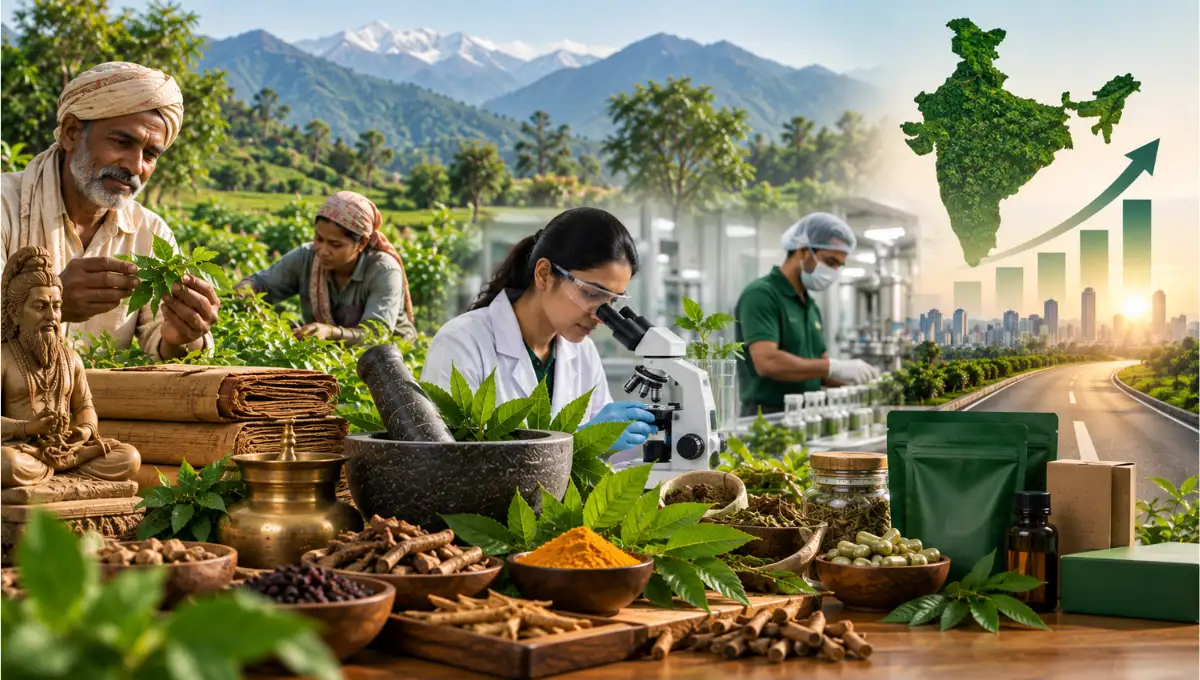



Ayurveda · AYUSH Industry · Wellness Innovation · India 2026
The Future of India's Natural Wellness Industry
India's natural wellness industry is in the middle of one of the most significant transformations in its long history, and it is happening on two fronts simultaneously. On one side, government policy, export ambition, and consumer demand are pushing the industry toward genuinely enormous scale. On the other, a quieter but equally important shift is underway toward the kind of quality verification, traceability, and scientific rigor that this industry has historically lacked. Understanding where India's natural wellness sector is actually headed, rather than where marketing language claims it already is, requires looking closely at both of these forces together.
- The Scale of Growth Already Underway
- How Government Policy Is Actively Shaping This Growth
- The Quality Bottleneck Standing in the Way of Bigger Ambitions
- Why AI and Blockchain Are Entering the Herb Supply Chain
- Wellness Tourism as a Genuinely Distinct Growth Engine
- How Consumer Expectations Are Quietly Raising the Bar
- What This Means for Brands Operating in This Space
- Frequently Asked Questions
- Final Word
The Scale of Growth Already Underway
The numbers behind India's natural wellness sector have reached a scale that would have seemed implausible even a decade ago. According to industry analysis compiled by the India Brand Equity Foundation, India's AYUSH industry, covering Ayurveda, Yoga, Unani, Siddha, and Homoeopathy, is projected to grow from roughly 43.3 billion US dollars in 2024 to as much as 200 billion US dollars by 2030, an eightfold expansion in under a decade. The same analysis notes that the sector has already seen a fifteen-fold rise over the ten years between 2015 and 2025, with India now supplying AYUSH medicines and products to more than 200 countries worldwide.
India's broader health and wellness market, which includes AYUSH alongside functional foods, nutraceuticals, and personal care, was valued at roughly 164 billion US dollars in 2025 according to IMARC Group's market research, with continued expansion projected through 2034. Within this broader category, the specifically Ayurvedic wellness segment alone was valued at close to 12 billion US dollars in 2025 and is projected to reach over 43 billion dollars by 2034, growing at a compound annual rate of nearly 15 percent, a pace that reflects genuinely accelerating rather than merely steady demand.
These figures matter for a specific reason beyond simple market size. Growth at this pace, sustained over multiple years, changes the entire competitive and regulatory environment a natural wellness brand operates within. An industry moving from tens of billions to potentially hundreds of billions of dollars in scale within a single decade attracts far more capital, far more scrutiny, and far more international attention than a smaller, slower-growing category typically would, and all three of those forces are actively reshaping how this industry now operates.
How Government Policy Is Actively Shaping This Growth
This growth is not happening organically without direction. The Ministry of AYUSH has released approximately 8.66 billion US dollars under the National AYUSH Mission between fiscal years 2015 and 2026 specifically to strengthen AYUSH infrastructure, expand healthcare facilities, and improve access to traditional medicine across the country, according to industry data compiled by IBEF. This is a genuinely substantial, sustained public investment, not a symbolic gesture, and it has directly funded the expansion of over 178,000 Ayushman Arogya Mandir wellness centers nationwide as part of the broader Ayushman Bharat initiative.
India's most recent Union Budget has extended this government focus specifically into the export and international dimension of the industry. The 2025-26 budget's "Heal in India" initiative allocated a dedicated 2.2 billion US dollars specifically to position Ayurveda, yoga, and naturopathy as exportable services within India's broader service economy, treating wellness tourism and traditional medicine export as a strategic economic priority rather than a cultural side note. This policy direction is already showing measurable results: exports of AYUSH and herbal products reached approximately 690 million US dollars in the 2025 financial year according to Ministry of Commerce and Industry data, and the government has separately introduced a dedicated AYUSH visa category specifically for foreign nationals traveling to India for treatment under Indian systems of medicine.
The Quality Bottleneck Standing in the Way of Bigger Ambitions
Growth at this scale has exposed a problem the industry can no longer treat as a minor footnote: quality inconsistency and sourcing opacity are now being explicitly named, by the government's own institutions, as the central obstacle to the industry's next phase of growth. At a recent industry gathering, representatives from the Ministry of Ayush, the National Medicinal Plant Board, and the World Health Organisation stated plainly that inconsistent plant quality and opaque sourcing continue to constrain the sector's domestic scale-up and export prospects, describing farm-level quality validation as increasingly a prerequisite for sustaining growth rather than an optional future upgrade.
This concern is directly tied to India's export ambitions specifically. Industry reporting has noted that Indian herbal exports increasingly need to comply with international quality frameworks like the European Pharmacopoeia, a regulatory standard considerably more rigorous than domestic Indian quality requirements have historically demanded. This creates a genuine structural tension: the same industry growth that government policy is actively driving also requires a level of supply chain quality assurance that much of the existing, fragmented, often informal Indian herb sourcing infrastructure was never originally built to provide.
Why AI and Blockchain Are Entering the Herb Supply Chain
This quality bottleneck is precisely why one of the most significant developments shaping India's natural wellness future is the direct, institutional push toward technology-enabled traceability. At a national seminar convened by the Ministry of Ayush and the National Medicinal Plant Board, alongside IIT Delhi, the World Health Organization, and India's Central Council for Research in Ayurvedic Sciences, experts reached a strong consensus that digital tools at the farm gate, including portable quality-testing devices, AI-enabled decision-support systems, and blockchain-based traceability platforms, are no longer optional but essential for ensuring the authenticity, safety, and global competitiveness of Indian herbal raw materials.
The specific mechanics of this shift are becoming concrete rather than theoretical. Industry analysis has highlighted blockchain traceability's potential to document a farmer's or wild collector's specific role in a high-value supply chain, from the point of geo-tagged collection all the way through to the final labeled formulation, a capability that directly addresses both the quality verification problem discussed above and the fair-sourcing transparency question that increasingly informed consumers are asking about. This is not a distant, speculative development. India's own Smart India Hackathon has directly listed the development of a blockchain-based system for botanical traceability of Ayurvedic herbs, explicitly including geo-tagging from the point of collection by farmers and wild collectors through to the final Ayurvedic formulation label, as an active national problem statement the Ministry of Ayush is actively seeking solutions for.
What this signals for the industry's near-term future is significant: the era in which an Ayurvedic brand could credibly claim quality and authenticity purely through reputation or tradition, without any independently verifiable documentation trail, is closing. The brands and supply chains that build genuine, technology-backed traceability now are positioning themselves ahead of what is rapidly becoming both a regulatory expectation and a competitive necessity, rather than scrambling to retrofit it once it becomes mandatory.
Wellness Tourism as a Genuinely Distinct Growth Engine
India's wellness tourism market represents a genuinely distinct growth vector from the packaged product side of the industry, and it is expanding rapidly in its own right. Industry analysis from Mordor Intelligence puts India's wellness tourism market at roughly 28.9 billion US dollars in 2025, projected to reach nearly 44 billion dollars by 2031, reflecting what analysts describe as a shift where travelers increasingly plan trips specifically around Ayurveda, yoga, naturopathy, and mental wellness programs, rather than treating these as incidental activities layered onto an otherwise conventional vacation.
What makes this growth vector particularly significant for the broader natural wellness industry is its distributed economic footprint. As research from Christ University's School of Business Management has noted, wellness tourism supports an unusually wide range of downstream businesses, hotels, homestays, transport providers, local food businesses, handicraft makers, therapists, and guides, creating livelihoods specifically in smaller towns and rural locations rather than concentrating economic benefit purely in major metro areas. This distributed benefit is part of why the sector has attracted such consistent, sustained government policy attention beyond its raw market size alone.
How Consumer Expectations Are Quietly Raising the Bar
Alongside the policy and technology shifts discussed above, Indian consumer expectations within the wellness category are themselves evolving in ways that are reshaping what brands need to offer to compete effectively. Industry analysis of India's D2C beauty and wellness sector has specifically noted that shoppers, including in Tier 2 and Tier 3 cities where much of the industry's newer growth is concentrated, increasingly value ingredient clarity, clinically supported claims, and formulations specifically designed around Indian skin, hair, and health needs, rather than accepting vague natural or traditional marketing claims at face value the way earlier generations of consumers more readily did.
This growing consumer sophistication is reinforcing, from the demand side, exactly the same direction that government policy and technology adoption are pushing from the supply side: toward verifiable quality, transparent sourcing, and evidence-backed formulation rather than tradition or brand recognition alone. A natural wellness industry moving simultaneously in this direction from regulatory pressure, technological capability, and consumer expectation all at once is not experiencing three separate, coincidental trends. It is experiencing a single, converging shift toward substantiated quality as the actual basis of competition in this category going forward.
What This Means for Brands Operating in This Space
Given everything above, here is what the future of India's natural wellness industry actually implies for a brand trying to build something durable within it.
Traceability Will Shift From Differentiator to Baseline Expectation
Given the direct institutional push toward blockchain and AI-enabled sourcing verification, brands that build genuine traceability into their supply chain now will be ahead of what is likely to become an increasingly standard requirement rather than a competitive advantage.
Export-Grade Quality Standards Will Increasingly Apply Domestically Too
As Indian herbal exports adapt to frameworks like the European Pharmacopoeia to meet international scrutiny, this same quality discipline is likely to gradually raise the baseline expectation for domestic Indian consumers as well, rather than remaining a separate standard reserved only for export-facing product lines.
Growth Will Increasingly Come From Beyond the Metro Markets
Given how much of India's overall consumer growth, wellness included, is concentrated in Tier 2 and Tier 3 cities, brands need to design their pricing, distribution, and communication strategy around these markets as a core priority rather than an eventual expansion phase.
Consumer Sophistication Will Keep Rising
As Indian consumers increasingly expect ingredient clarity and evidence-backed claims rather than accepting tradition alone as sufficient justification, brands relying purely on heritage marketing without substantive quality documentation behind it will find this positioning increasingly insufficient.
This is precisely the direction that forward-looking Ayurvedic wellness brands need to be building toward now, treating batch-tested quality, transparent sourcing, and genuine traceability as foundational rather than optional. ACTIZEET® is one example of a brand in this category already oriented toward this future, treating independent testing and sourcing documentation as a core part of its operating model rather than a response to future regulation, positioning it well for an industry that is clearly moving in exactly this direction.
Frequently Asked Questions
According to industry analysis compiled by the India Brand Equity Foundation, India's AYUSH industry is projected to grow from approximately 43.3 billion US dollars in 2024 to as much as 200 billion US dollars by 2030. India's broader health and wellness market, which includes AYUSH alongside functional foods and personal care, was valued at roughly 164 billion US dollars in 2025 according to IMARC Group, with continued growth projected through 2034.
Government investment has been substantial and sustained. The Ministry of AYUSH has released approximately 8.66 billion US dollars under the National AYUSH Mission between FY2015 and FY2026, and the 2025-26 Union Budget's "Heal in India" initiative allocated a dedicated 2.2 billion US dollars specifically to position Ayurveda, yoga, and naturopathy as exportable services within India's economy.
Experts from the Ministry of Ayush, the National Medicinal Plant Board, IIT Delhi, and the World Health Organization have identified inconsistent plant quality and opaque sourcing as central obstacles to the industry's continued growth and export competitiveness. AI-enabled quality assessment and blockchain traceability are being actively developed to verify plant authenticity and document the supply chain from farm-level collection through to the finished product, directly addressing this quality and transparency gap.
Yes, and it is growing as a genuinely distinct category. Industry research from Mordor Intelligence values India's wellness tourism market at roughly 28.9 billion US dollars in 2025, projected to reach nearly 44 billion dollars by 2031, driven by travelers increasingly planning trips specifically around Ayurveda, yoga, and naturopathy programs. This growth has a notably distributed economic benefit, supporting businesses in smaller towns and rural areas beyond major metro cities.
Final Word: An Industry Growing Up as Fast as It Is Growing Big
India's natural wellness industry is not simply getting larger. It is maturing in real time, under direct pressure from government policy, international export standards, emerging technology, and an increasingly sophisticated domestic consumer base, all pushing in the same fundamental direction: toward quality that can actually be verified rather than simply claimed. The scale of growth ahead, potentially reaching hundreds of billions of dollars within the next decade, is genuinely extraordinary. But the brands, farmers, and institutions that will actually capture that growth sustainably are the ones building the traceability, quality discipline, and consumer trust this future clearly demands, rather than the ones betting that tradition and marketing language alone will be enough to carry them forward.