

Ashwagandha Buying Guide · Brand Comparison · Root vs Extract
ACTIZEET® Ashwagandha Powder vs Other Ashwagandha Brands: An Honest Comparison
Ashwagandha has gone from a quiet Ayurvedic kitchen staple to one of the most popular wellness herbs in the world. Today you can buy it as a plain root powder, a high-strength extract capsule, a flavoured gummy, a fizzy tablet or one ingredient among ten in a "stress blend." Every option claims to be pure and effective. So how do you choose? In this guide, we compare ACTIZEET® Ashwagandha Powder with the main types of ashwagandha products sold in India, using clear criteria: plant part, form, purity, additives, testing, dose and value. We will also be honest about where other formats have real advantages, so you can pick what suits your needs.
- What Ashwagandha Is and Why Products Differ
- Quick Comparison Table
- 1. Plant Part: Root vs Leaf
- 2. Form: Powder vs Extract, Capsules and Gummies
- 3. Withanolides and Standardization
- 4. Additives, Fillers and Blends
- 5. Purity and Lab Testing
- 6. Dose, Flexibility and Daily Use
- 7. Price and Value
- How to Spot Good Ashwagandha Powder
- Which Option Is Right for You?
- How to Use and Safety Notes
- Frequently Asked Questions
- Final Verdict
What Ashwagandha Is and Why Products Differ
Ashwagandha, known botanically as Withania somnifera and sometimes called Indian ginseng or winter cherry, is a small shrub widely grown in dry parts of India, especially Madhya Pradesh and Rajasthan. Its root has been used in Ayurveda for centuries as a rasayana, a rejuvenating herb traditionally taken for strength, vitality and calm. The name itself comes from Sanskrit and refers to the root's distinctive earthy, horse-like smell.
Modern research has added interest. The U.S. National Center for Complementary and Integrative Health (NCCIH) notes that some studies suggest ashwagandha may help with stress and sleep, while also pointing out that many of these studies were small and short, and that more research on long-term safety is needed. This balanced view is a good starting point for any buyer.
Why Two "Pure Ashwagandha" Products Can Be Very Different
Ashwagandha products vary in which part of the plant is used, whether the herb is simply dried and ground or chemically extracted, what else is added, how carefully it is tested, and how much you actually take each day. These details matter far more than the word "pure" on the front of a pack.
Quick Comparison Table
Instead of naming individual competitors, this table compares ACTIZEET® with the common categories of ashwagandha products in the Indian market. Products within each category vary, so always check the specific label and lab report.
| Criteria | ACTIZEET® Root Powder | Extract Capsules / Tablets | Gummies / Effervescent | Unbranded Loose Powder |
|---|---|---|---|---|
| Plant part | Root only (Withania somnifera) | Usually root; some older products used root and leaf | Often not clearly stated | Unknown, may include stems |
| Form | Finely milled whole root (traditional churna) | Concentrated extract | Extract in a sweet or fizzy base | Ground material, processing unknown |
| Additives | Single ingredient; no artificial colours, flavours or preservatives | Capsule shell, excipients, binders | Sugar or sweeteners, flavours, gelling agents | Risk of fillers or adulteration |
| Withanolide disclosure | Whole-root profile, not standardized to a fixed % | Often standardized to a stated % | Sometimes stated, often low per serving | Not stated |
| Testing | Batch quality evaluations, tested for purity (as stated by the brand) | Varies by brand | Varies by brand | Usually none |
| Typical daily amount | About 3 to 5 g, adjustable | Fixed capsule dose, often a few hundred mg of extract | Fixed, often low dose | Adjustable, potency unknown |
| Taste and convenience | Earthy, bitter taste; mixes into milk, water or recipes | Very convenient, no taste | Pleasant taste, easy | Earthy taste |
The sections below explain each point in plain language.
See the Root Powder We Are Comparing
100% Withania somnifera root, finely milled, with no artificial colours, flavours or preservatives.
View ACTIZEET® Ashwagandha Powder1. Plant Part: Root vs Leaf
This is the single most important point in any ashwagandha comparison, and it has recently become a regulatory issue in India.
Why the Root Matters
Classical Ayurvedic use of ashwagandha centres on the root. The leaves have a different chemical profile, including higher levels of certain reactive withanolides such as withaferin A. For years, some manufacturers used leaves, or blends of root and leaf, because leaves are cheaper and easier to harvest.
India's Leaf Restriction
In April 2026, the Food Safety and Standards Authority of India issued an advisory on the non-use of ashwagandha leaves in crude, extract or any other form in food products. It followed guidance from the Ministry of Ayush directing manufacturers to use the root and to label the plant parts used, citing safety concerns linked to leaf material. For buyers, the message is clear: choose products that state "root" plainly on the label.
ACTIZEET®
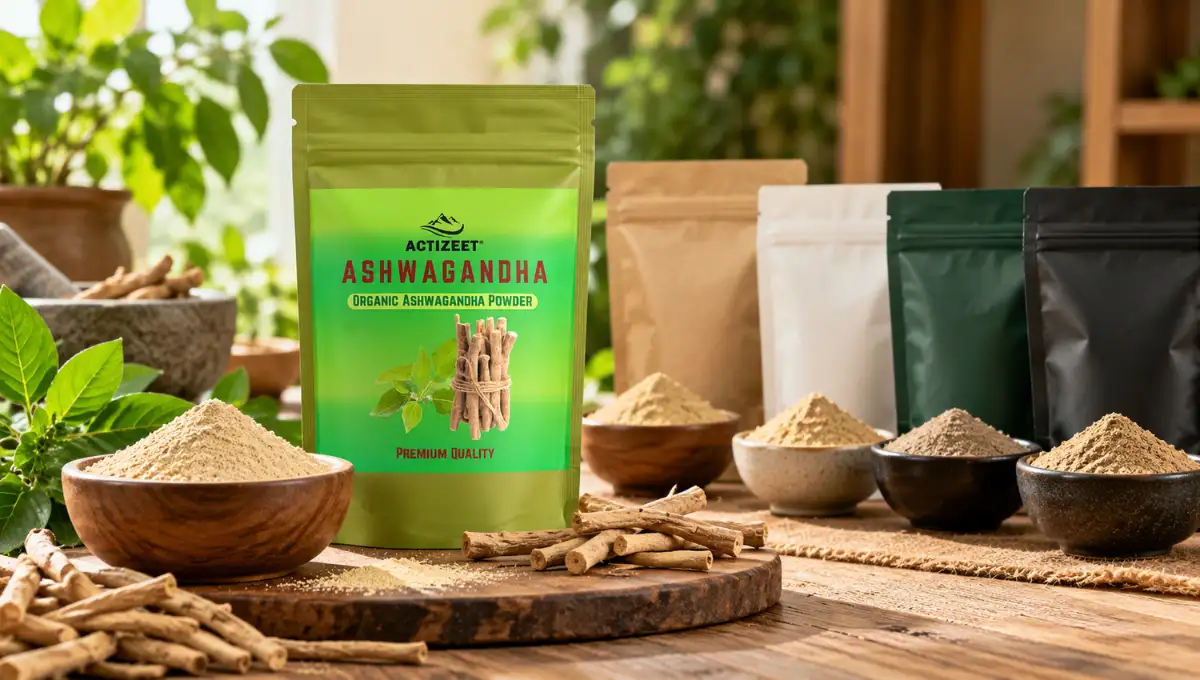
ACTIZEET® Ashwagandha Powder is made from carefully selected Withania somnifera roots, with ashwagandha root powder as its only listed ingredient.
Other Brands
Most reputable brands now use root only, but older stock, imported products and unbranded powders may not make this clear. If a label just says "ashwagandha" without naming the plant part, treat that as a reason to ask questions.
2. Form: Powder vs Extract, Capsules and Gummies
Root Powder (ACTIZEET®)
Root powder, known in Ayurveda as ashwagandha churna, is the traditional form. The root is dried and finely milled, so you get the whole root with its full natural range of compounds, fibre and all. It is typically mixed into warm milk, a classic preparation, or into water, smoothies or food. ACTIZEET® follows this approach. The trade-offs are a larger serving size and a bitter, earthy taste.
Extract Capsules and Tablets
Extracts are made by soaking the root in a solvent, often water or water and alcohol, then concentrating the result. This produces a smaller, stronger dose that fits in a capsule. Many well-known clinical studies used standardized root extracts, which is a genuine advantage of this format. On the other hand, extraction selects certain compounds over others, adds processing steps and usually costs more per serving.
Gummies and Effervescent Tablets
These formats are designed for taste and convenience. They can be a pleasant way to take a herb, but they often contain sugar, sweeteners or flavourings, and the amount of ashwagandha per serving is sometimes small or unclear.
Unbranded Loose Powder
Loose powder from local markets can be cheap, but without a label, plant-part declaration or testing, you have no way to confirm what you are buying.
3. Withanolides and Standardization
Withanolides are a group of naturally occurring compounds in ashwagandha and are widely used as quality markers. You will often see percentages such as "standardized to 5% withanolides" on extract labels.
What a Percentage Tells You
A stated withanolide percentage shows that a manufacturer measures one group of compounds and keeps it consistent. That is useful. But a higher number is not automatically better. Different labs use different methods, some figures include leaf-derived compounds, and the root contains many other substances beyond withanolides that traditional practice values.
Whole Root vs Standardized Extract
ACTIZEET® Ashwagandha Powder is a whole-root churna rather than a standardized extract, so it is not sold with a fixed withanolide percentage. Its strength comes from the natural profile of the whole root in a traditional serving size. If you specifically want a measured, concentrated withanolide dose to match a particular clinical study, a standardized extract may suit you better. If you prefer the whole herb in its traditional form, root powder is the closer match.
4. Additives, Fillers and Blends
For a single-herb product, a short ingredient list is one of the easiest quality signals to check.
ACTIZEET®
ACTIZEET® lists ashwagandha root powder as its only ingredient and states that it contains no artificial colours, flavours or preservatives. It is also described as gluten-free and 100 percent vegetarian.
Other Formats
Capsules commonly include anti-caking agents, binders and a capsule shell. Gummies may add sugar, colours and flavours. Multi-herb "stress" or "sleep" blends combine ashwagandha with other herbs, which can be useful, but they make it harder to know how much ashwagandha you are actually taking. Unbranded powders carry the risk of starch, husk or other cheap fillers being mixed in.
5. Purity and Lab Testing
Herbal powders are farm products. They can pick up dust, microbes, pesticide residues or heavy metals from soil and water if they are not grown, dried and stored carefully.
This concern is well documented. A study led by Boston University researchers and published in JAMA (the Journal of the American Medical Association) tested 193 Ayurvedic products sold online and found that about one in five contained detectable lead, mercury or arsenic. That study looked at Ayurvedic products broadly rather than ashwagandha alone, but it shows why testing matters for every herbal product.
ACTIZEET®
ACTIZEET® states that its ashwagandha powder goes through batch quality evaluations, is tested for purity and is processed under hygienic conditions. As with any herbal product, including ours, we encourage you to ask for the latest batch report.
What a Good Lab Report Should Show
- Identity confirmation that the material is Withania somnifera root.
- Heavy metal results for lead, arsenic, cadmium and mercury, with numbers and limits.
- Microbial counts and absence of harmful organisms.
- Pesticide residue screening.
- A batch number matching your pack, a named lab and a date.
6. Dose, Flexibility and Daily Use
Root Powder
Root powder is taken in grams rather than milligrams. ACTIZEET® suggests mixing about 3 to 5 grams into warm milk, water, smoothies, herbal drinks, yogurt or recipes. Because it is a powder, you can start with a smaller amount and adjust within the label's guidance. Many people enjoy the traditional ritual of a warm ashwagandha drink in the evening.
Extract Capsules
Extract capsules usually deliver a few hundred milligrams of concentrated extract in a fixed dose. This is ideal for people who travel a lot or do not want to taste the herb, but it offers less flexibility.
Consistency Matters Most
Whatever form you choose, ashwagandha is traditionally taken regularly over weeks rather than as a one-off. The best format is often the one you will actually use every day.
7. Price and Value
- Compare cost per day, not per pack. A powder at 3 to 5 g per day and an extract capsule at a few hundred mg per day are very different products, so work out what each day of use costs.
- Check what you are paying for. With gummies and blends, part of the price goes to other ingredients and flavourings.
- Beware of very cheap powder. Low prices can point to leaf or stem content, old stock or no testing.
- Choose a pack size that suits you. ACTIZEET® Ashwagandha Powder comes in 100 g, 200 g and 300 g packs, so you can start small and move up if it fits your routine.
How to Spot Good Ashwagandha Powder
A few simple checks can tell you a lot before you buy or open a pack.
Read the Label Carefully
Look for the botanical name Withania somnifera, the word "root," a short ingredient list, a batch number, a manufacturing date and a licence number.
Use Your Senses
Good root powder is usually light beige to pale brown with a fine texture and a distinct earthy smell. A strong green tint can suggest leaf content, while a musty smell may point to poor storage.
Know the Limits
Colour and smell offer clues, but they cannot reveal heavy metals, microbes or pesticides. Only a lab report can do that.
Which Option Is Right for You?
Choose a Root Powder Like ACTIZEET® If You:
- Want ashwagandha in its traditional whole-root churna form.
- Prefer a single-ingredient product with no artificial additives.
- Like mixing herbs into warm milk, drinks or food.
- Want to adjust your serving within the label's guidance.
- Are comfortable with an earthy taste.
Consider a Standardized Root Extract If You:
- Want a small, fixed, tasteless dose.
- Want to match the specific extract used in a particular study.
- Can confirm the extract is root-only and backed by lab reports.
Be Cautious With:
- Any product that does not say "root" on the label.
- Gummies with high sugar and unclear ashwagandha content.
- Loose powder with no brand, batch number or testing.
- Products promising to cure anxiety, insomnia or other conditions.
How to Use and Safety Notes
Simple Ways to Take Ashwagandha Powder
- Traditional milk: Stir into a cup of warm milk, with a little jaggery or honey if you like.
- Warm water: A quick option for those avoiding dairy.
- Smoothies or yogurt: Fruit and yogurt help soften the taste.
- Recipes: Add to laddoos, energy balls or porridge.
Store the pack in a cool, dry place, away from moisture and sunlight, and close it tightly after use.
Who Should Speak to a Doctor First
Ashwagandha is not right for everyone. According to NCCIH, it may be unsafe during pregnancy, and there have been rare reports of liver problems linked to ashwagandha supplements. Please consult a qualified healthcare professional before use if you:
- Are pregnant, trying to conceive or breastfeeding.
- Have a thyroid condition, an autoimmune condition or liver concerns.
- Take medicines for diabetes, blood pressure, thyroid, sleep or anxiety, or immunosuppressants.
- Have surgery planned.
- Are buying for a child or teenager.
Stop using it and seek medical advice if you notice unusual symptoms. Ashwagandha is a traditional wellness herb, not a replacement for medical treatment.
Root-Only. Single Ingredient. Tested for Purity.
Available in 100 g, 200 g and 300 g packs for your daily wellness routine.
Shop ACTIZEET® Ashwagandha PowderFrequently Asked Questions
ACTIZEET® is a single-ingredient powder made only from Withania somnifera roots, with no artificial colours, flavours or preservatives. The brand states that it goes through batch quality evaluations and is tested for purity. Many other products are extracts, gummies or blends with added ingredients, or loose powders with no plant-part declaration.
Neither is better for everyone. Root powder is the traditional whole-herb form with flexible dosing and no fillers. Extract capsules are more concentrated, tasteless and convenient, and many clinical studies used standardized extracts. Choose based on your preference, and make sure either option is root-only and tested.
Traditional use focuses on the root, and leaves have a different chemical profile. In April 2026, FSSAI issued an advisory against the use of ashwagandha leaves in any form in food products, following Ministry of Ayush guidance citing safety concerns.
For ACTIZEET® Ashwagandha Powder, the brand suggests about 3 to 5 grams mixed into warm milk, water, smoothies or food. Do not exceed the label's recommended serving, and consult a healthcare professional if you have a medical condition or take medication.
Check for the botanical name Withania somnifera, the word "root," a short ingredient list, a batch number and a licence number. Genuine root powder is usually beige to light brown with an earthy smell. For safety, ask for a batch lab report covering heavy metals and microbes.
Final Verdict: Root First, Then Purity, Then Preference
The ashwagandha shelf is crowded, but the decision becomes much simpler when you focus on what actually matters. First, make sure the product is made from the root only, a point India's regulators have now made very clear. Second, check for a short, honest ingredient list and evidence of testing. Third, choose the form that suits your routine. Standardized root extracts are a sensible choice for people who want a small, fixed, tasteless dose. ACTIZEET® Ashwagandha Powder is built for those who want ashwagandha the traditional way: 100 percent Withania somnifera root, finely milled, with no artificial colours, flavours or preservatives, and tested for purity. Whichever product you pick, read the label, ask for the lab report and treat ashwagandha as a steady daily companion rather than a quick fix.
Ready to try pure ashwagandha root powder?
Buy ACTIZEET® Ashwagandha Powder