

Shilajit Buying Guide · Brand Comparison · Purity & Testing
ACTIZEET® Shilajit vs Other Shilajit Brands: An Honest Comparison
Search for shilajit online and you will find hundreds of options: sticky resins in glass jars, capsules, tablets, powders, flavoured gummies and liquid drops, priced anywhere from a few hundred rupees to several thousand. Almost all of them promise "pure Himalayan shilajit." So how do you tell them apart? In this guide, we compare ACTIZEET® Himalayan Shilajit Resin with the main types of shilajit products sold in India, using clear, practical criteria: source, form, purification, additives, fulvic acid disclosure, lab testing and transparency. We also explain where other formats make sense, so you can choose what fits you rather than what is advertised loudest.
- What Shilajit Is and Why Quality Varies So Much
- Quick Comparison Table
- 1. Source and Altitude
- 2. Form: Resin vs Capsules, Powder, Gummies and Drops
- 3. Purification Method
- 4. Additives and Fillers
- 5. Fulvic Acid and Active Compounds
- 6. Lab Testing and Heavy Metal Safety
- 7. Transparency and Ethical Sourcing
- 8. Price and Real Value Per Serving
- Can You Test Shilajit at Home?
- Which Option Is Right for You?
- How to Use Shilajit Resin and Safety Notes
- Frequently Asked Questions
- Final Verdict
What Shilajit Is and Why Quality Varies So Much
Shilajit is a dark, sticky, mineral-rich substance that seeps out of rock crevices in high mountain ranges, especially the Himalayas, during warm months. It forms very slowly from plant matter broken down by microbes over long periods. In Ayurveda, it has been valued for centuries as a rasayana, a rejuvenating substance for strength and vitality.
Scientifically, shilajit is described as a complex mixture rather than a single compound. A review published in the International Journal of Alzheimer's Disease (available via the U.S. National Library of Medicine) explains that shilajit is made up mainly of humic substances, with fulvic acid considered its main active principle, alongside compounds called dibenzo-α-pyrones. The same review notes that more clinical research is still needed to fully understand how these compounds act in the body.
Why Two "Pure Shilajit" Products Can Be Very Different
Because raw shilajit is a natural rock exudate, it comes mixed with soil, stone particles and other impurities. Its quality depends on where it was collected, how it was purified, whether anything was added, and how carefully it was tested. That is why two products with nearly identical labels can differ hugely in what they actually contain.
Quick Comparison Table
Rather than naming individual competitors, this table compares ACTIZEET® with the common categories of shilajit products you will find in India. Products within each category vary, so use this as a general guide and always check the specific label and lab report.
| Criteria | ACTIZEET® Resin | Capsules / Tablets | Gummies / Drops | Unbranded Loose Resin |
|---|---|---|---|---|
| Form | Purified resin, closest to traditional form | Dried extract or powder | Extract mixed into a sweet or liquid base | Resin of unknown processing |
| Stated source | High-altitude Himalayan rock, Ladakh region (as stated by the brand) | Often "Himalayan," region rarely specified | Often not specified | Usually unverifiable |
| Purification | Traditional Surya Taapi (sun-based) method | Varies, often industrial extraction and drying | Varies, rarely disclosed | Often unknown or minimal |
| Additives | No added fillers or preservatives (as stated by the brand) | Often excipients, binders or capsule shells | Often sugar, flavours, gelling agents | Risk of undisclosed adulterants |
| Fulvic acid disclosure | Brand states 60%+ fulvic acid | Sometimes stated | Rarely stated per serving | Not stated |
| Lab testing | Tested for purity, fulvic acid and safety (as stated by the brand) | Varies by brand | Varies by brand | Usually none |
| Dose flexibility | Easy to adjust a pea-sized portion | Fixed dose per capsule | Fixed, often low dose | Adjustable, but potency unknown |
| Convenience and taste | Earthy taste, needs dissolving in warm water or milk | Very convenient, no taste | Pleasant taste, easy to take | Earthy taste |
The sections below explain each criterion in plain language, including where other formats have genuine advantages.
Want to see the resin we are comparing?
Explore pack sizes, usage guidance and product details for ACTIZEET® Himalayan Shilajit Resin.
View ACTIZEET® Shilajit Resin1. Source and Altitude
Shilajit is found in several mountain ranges, including the Himalayas, Altai, Caucasus and Andes. Within the Himalayas, quality can still vary from one location to another, depending on the local plant life, rock type and exposure to pollution.
ACTIZEET®
According to the brand, ACTIZEET® shilajit is collected from high-altitude rock faces in the Ladakh region, at roughly 14,000 to 16,000 feet, in areas away from industrial activity. Naming a specific region gives buyers something concrete to evaluate, rather than a broad "Himalayan" label.
Other Brands
Many products simply say "Himalayan shilajit" without naming a region. Some unbranded resins sold through informal channels may not come from the Himalayas at all. A vague source is not proof of poor quality, but it does mean you have less information to judge the product.
What to look for: A named region, an explanation of how and when it is collected, and consistency between what the brand says and what its lab reports show.
2. Form: Resin vs Capsules, Powder, Gummies and Drops
The form of shilajit you buy affects how close it is to the traditional material, how much processing it has gone through and how easy it is to check.
Resin (ACTIZEET®)
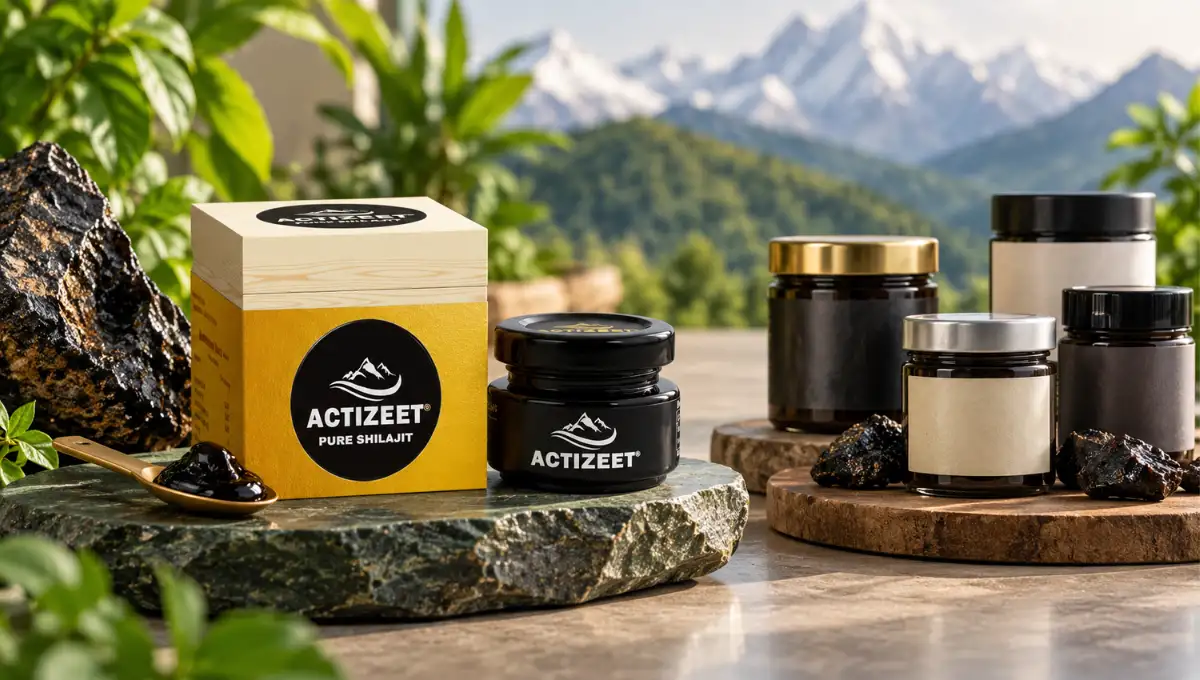
Purified resin is the form most closely linked to traditional Ayurvedic use. It has a recognisable texture: firm when cool, softer and more pliable when warm, and it dissolves in warm water. ACTIZEET® is sold as a resin, which keeps processing to a minimum and allows flexible dosing. The trade-off is a strong, earthy taste that some people need time to get used to.
Capsules and Tablets
Capsules and tablets usually contain dried shilajit extract or powder. Their big advantage is convenience: no taste, easy to carry and a fixed dose. The downside is that drying and powdering involve extra processing, and once shilajit is in powder form, its natural texture can no longer help you judge authenticity. Some formulations also add other herbs, which makes it harder to know how much shilajit you are actually getting.
Gummies and Liquid Drops
Gummies and drops are the newest formats. They taste better and suit people who dislike the flavour of resin. However, they often include sugar, flavourings and gelling agents, and the amount of actual shilajit per serving can be low or not clearly stated.
Loose Unbranded Resin
Loose resin sold without a brand, label or lab report is the riskiest option. It may look similar to genuine resin, but without testing, there is no way to know what it contains.
3. Purification Method
Raw shilajit is never ready to eat straight from the rock. Purification, known in Ayurveda as shodhana, removes soil, stones and other impurities. How this is done affects both safety and the final composition.
Surya Taapi: The Sun-Based Method
In the traditional Surya Taapi method, raw shilajit is dissolved in water, filtered, and the clear solution is left to concentrate slowly under sunlight over a period of time. It is slow and labour-intensive, but it avoids high heat. ACTIZEET® states that it follows the Surya Taapi purification method to help preserve shilajit's natural characteristics.
Agni Taapi and Industrial Methods
Agni Taapi uses fire or heat to concentrate the solution more quickly. Many commercial manufacturers use industrial heating, spray drying or solvent-based extraction to produce powders and extracts at scale. These methods are faster and cheaper, and they can still produce acceptable products when well controlled, but higher heat may affect some of the more delicate compounds.
What to look for: A brand that tells you which purification method it uses. If a label says nothing about purification at all, treat that as a reason to ask questions.
4. Additives and Fillers
One of the easiest ways to compare brands is to read the ingredient list. For a single-ingredient product like shilajit, a short list is usually a good sign.
ACTIZEET®
ACTIZEET® positions its resin as a single-ingredient product with no added fillers, additives or preservatives, according to the brand's own sourcing information.
Other Formats
Capsules commonly contain excipients such as anti-caking agents, binders and capsule shells. These are generally safe, but they mean each serving is not pure shilajit. Gummies may contain sugar or sweeteners, flavours and colours. With unbranded resins, the biggest concern is undisclosed adulteration, such as mixing in cheaper tar-like materials to add weight.
5. Fulvic Acid and Active Compounds
Fulvic acid is widely used as a marker of shilajit quality, because research identifies it as one of shilajit's main active components. Dibenzo-α-pyrones (DBPs) are another group of compounds often discussed.
ACTIZEET®
ACTIZEET® states that its resin contains fulvic acid at 60 percent or more, and that it tests for fulvic acid content. It also describes its resin as containing DBPs and a broad range of naturally occurring minerals.
Other Brands
Some brands state a fulvic acid percentage, while many do not. Be aware that very high percentages are sometimes quoted without saying how they were measured. Different test methods can give different numbers, so a percentage is most meaningful when it comes with a named lab and method.
What to look for: A stated fulvic acid figure, ideally confirmed in a batch-specific lab report.
6. Lab Testing and Heavy Metal Safety
This is the single most important point in any shilajit comparison. Because shilajit is a mineral-rich substance from rock, it can contain heavy metals if it is not properly sourced and purified.
Concerns about metals in traditional remedies are well documented. A study led by Boston University researchers and published in JAMA (the Journal of the American Medical Association) tested 193 Ayurvedic products sold online and found that about one in five contained detectable lead, mercury or arsenic. While that study looked at Ayurvedic products broadly rather than shilajit alone, it shows why testing matters for every mineral-rich supplement.
ACTIZEET®
ACTIZEET® describes its resin as lab-tested for purity, fulvic acid and safety. If you are considering any shilajit, including ours, we encourage you to ask for the latest lab report and check that it covers heavy metals.
Other Brands
Testing practices vary widely. Some brands share detailed reports, some mention testing without showing results, and many unbranded sellers do no testing at all.
How to Read a Shilajit Lab Report
- Check that the batch number matches your pack.
- Look for lead, arsenic, cadmium and mercury results with actual numbers and limits.
- Check for microbial testing results.
- See whether fulvic acid content is reported.
- Confirm that the lab is named and the report is dated, ideally from an accredited lab.
Quality standards for Ayurvedic materials in India are published by the Pharmacopoeia Commission for Indian Medicine & Homoeopathy (PCIM&H) under the Ministry of Ayush, which is a useful reference point when judging test results.
7. Transparency and Ethical Sourcing
Shilajit forms extremely slowly and cannot be farmed. That makes responsible collection and fair treatment of collectors important, both for long-term supply and for the communities involved.
ACTIZEET®
ACTIZEET® publishes information about its sourcing, describing collection by local mountain communities and cooperatives using traditional methods. The brand also says it follows a practice of leaving a large share of resin untouched at collection sites so they can continue producing in future.
Other Brands
Many brands say little about who collects their shilajit or how. Again, silence does not automatically mean bad practice, but transparency gives you more confidence in what you are paying for.
8. Price and Real Value Per Serving
Shilajit prices vary enormously, and the cheapest option is rarely the best value. Here are a few points to keep in mind when comparing:
- Compare cost per serving, not per pack. A 20 g jar of resin at a typical daily serving of 300 to 500 mg lasts far longer than many people expect.
- Check what each serving contains. A cheap capsule with mostly filler, or a gummy with very little shilajit, may cost more per gram of actual shilajit.
- Be cautious of very low prices. Genuine high-altitude resin is labour-intensive to collect and purify. A price that seems too good to be true deserves extra scrutiny.
- Factor in testing. Part of what you pay for in a reputable brand is the testing that protects your health.
ACTIZEET® resin is available in several pack sizes, so you can start small and move to larger packs if it suits you. Current prices are listed on the product page.
Can You Test Shilajit at Home?
Many buyers try simple home checks. They can offer clues, but none of them replace a lab test.
The Solubility Check
Genuine purified resin usually dissolves fully in warm water, turning it a golden-brown to dark colour without leaving gritty particles. Heavy residue may suggest impurities.
The Temperature Check
Good resin tends to become firm and brittle when cold and soft and stretchy when warmed in your fingers.
The Limits of Home Tests
These checks cannot detect heavy metals, microbial contamination or clever adulteration. Some fake products are designed to pass them. That is why a batch-specific lab report from a named laboratory is the only reliable proof of purity, whichever brand you choose.
Which Option Is Right for You?
Choose a Purified Resin Like ACTIZEET® If You:
- Want shilajit in the form closest to traditional Ayurvedic use.
- Prefer a single-ingredient product without fillers.
- Value clear sourcing information and a named purification method.
- Like being able to adjust your serving size.
- Do not mind an earthy taste, or are happy to take it in warm milk or water.
Consider Capsules If You:
- Strongly dislike the taste and need maximum convenience.
- Travel often and want a fixed, portable dose.
- Can find a brand that clearly states shilajit content per capsule and shares lab reports.
Be Cautious With:
- Gummies with high sugar and unclear shilajit content.
- Loose resin with no brand, label or lab report.
- Any product making dramatic promises about curing diseases.
How to Use Shilajit Resin and Safety Notes
Typical Use
The brand's usage guidance for ACTIZEET® resin is a pea-sized amount, about 300 to 500 mg, once daily. Most people dissolve it in a cup of warm water, milk or herbal tea. Starting at the lower end and staying consistent is a sensible approach.
Who Should Speak to a Doctor First
- Pregnant or breastfeeding women.
- Children and teenagers.
- People with existing medical conditions, including heart, kidney or blood disorders.
- Anyone taking prescription medicines.
Shilajit is a dietary and traditional wellness product. It is not a replacement for medical treatment, and no shilajit brand should claim to cure disease.
Choose Shilajit You Can Check
High-altitude Himalayan resin, Surya Taapi purified, no added fillers, and lab-tested for purity and safety.
Shop ACTIZEET® Himalayan Shilajit ResinFrequently Asked Questions
ACTIZEET® is a single-ingredient Himalayan shilajit resin that, according to the brand, is sourced from high-altitude Ladakh rock faces, purified using the traditional Surya Taapi method, made without added fillers or preservatives, and lab-tested for purity, fulvic acid and safety. Many other products are capsules, gummies or unbranded resins with less information about source, purification and testing.
Resin is closer to the traditional form, usually involves less processing and allows flexible dosing. Capsules are more convenient and have no taste. A well-tested capsule can be a reasonable choice, but resin from a transparent, tested source is generally preferred by people who want shilajit in its most traditional form.
Genuine purified resin usually dissolves fully in warm water and softens with warmth. However, home tests cannot detect heavy metals or clever adulteration. The most reliable proof is a batch-specific lab report from a named laboratory showing heavy metal, microbial and fulvic acid results.
Surya Taapi is a traditional Ayurvedic method in which raw shilajit is dissolved in water, filtered, and slowly concentrated using sunlight rather than high heat. It is slower than heat-based methods and is valued for its gentle approach.
For ACTIZEET® resin, the brand suggests a pea-sized amount of about 300 to 500 mg once a day, dissolved in warm water or milk. Always follow the label of the product you use, and consult a healthcare professional if you are pregnant, breastfeeding, managing a health condition or taking medication.
Final Verdict: Compare Evidence, Not Labels
Almost every shilajit product claims to be pure, Himalayan and powerful. The real differences lie underneath: where it was collected, how it was purified, what else is in the jar or capsule, how much fulvic acid it contains and whether a lab has checked it for heavy metals. Capsules and gummies offer convenience, and some are made well. Unbranded loose resin carries the most uncertainty. ACTIZEET® Himalayan Shilajit Resin is built for buyers who want shilajit in its traditional resin form, with a named high-altitude source, Surya Taapi purification, no added fillers and lab testing for purity and safety. Whichever product you choose, ask for the lab report, read the ingredient list and be wary of promises that sound too good to be true. Your health deserves proof, not just a label.
Ready to try authentic Himalayan shilajit resin?
Buy ACTIZEET® Shilajit Now