

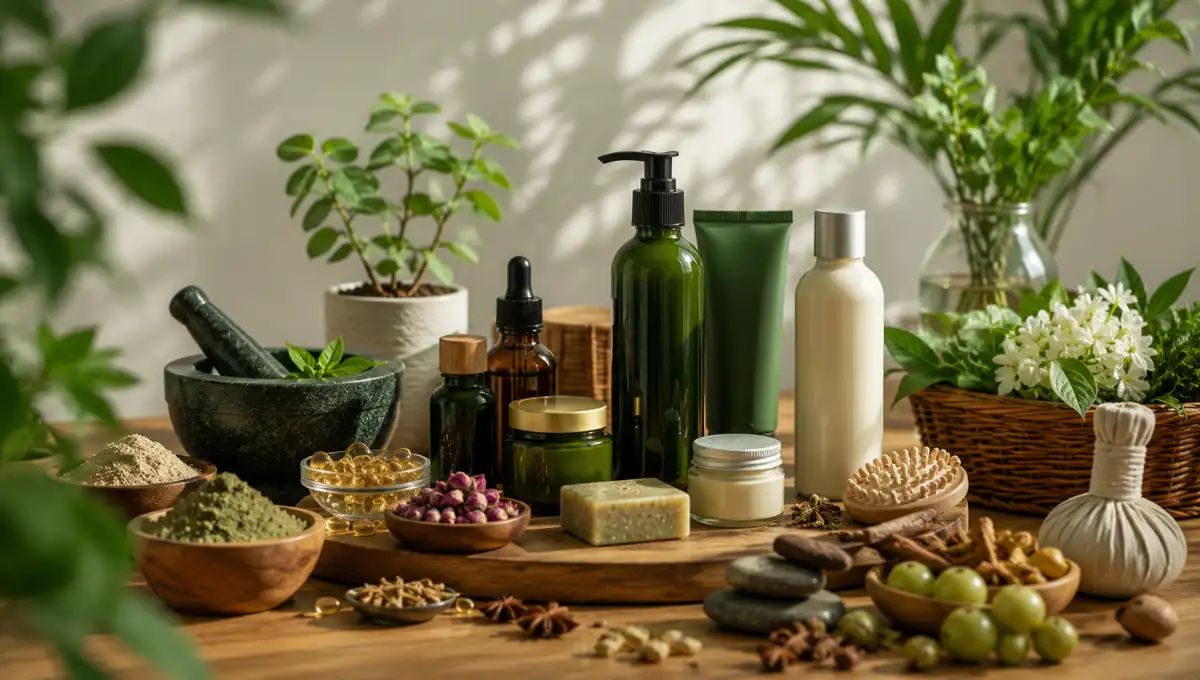

Consumer Wellness · Product Transparency · Industry Insight
What Are Natural Consumer Products? A Modern Industry Perspective
Walk down any supermarket aisle, scroll through any wellness app, or open any skincare marketplace and the word "natural" is everywhere, printed in green lettering on packaging, repeated in Instagram captions, and used as a shorthand for "safe," "clean," or "better for you." The strange part is that almost nobody selling these products, and surprisingly few people buying them, could give you a precise definition of what "natural" actually means. This is not a small gap. The natural products industry now represents tens of billions of dollars in annual spending, and the word doing most of the marketing work has no single, universally enforced legal definition. Understanding what natural consumer products genuinely are, how the term is regulated, where the market is heading, and how to evaluate a "natural" claim critically has become a genuinely useful skill for any modern consumer.
- Defining "Natural": Why It Is Harder Than It Sounds
- What Regulators Actually Say About "Natural" Claims
- The Main Categories of Natural Consumer Products
- Why the Natural Products Market Keeps Growing
- Natural vs. Clean vs. Organic: Untangling the Labels
- Greenwashing and Why Skepticism Is Healthy
- How to Actually Evaluate a Natural Product
- Frequently Asked Questions
- Final Word
Defining "Natural": Why It Is Harder Than It Sounds
At its simplest, a natural consumer product is one made primarily or entirely from ingredients derived from plants, minerals, animals, or other naturally occurring sources, processed minimally enough that the ingredients retain a recognizable connection to their origin, rather than being synthesized from petrochemicals or manufactured entirely in a lab. That definition sounds reasonable until you start applying it to real products, at which point it falls apart almost immediately.
Consider a genuinely simple question: is a vitamin C supplement natural if the ascorbic acid was synthesized in a factory to be molecularly identical to the vitamin C found in an orange? Is a shampoo natural if 95 percent of its ingredients come from plants but it contains a small amount of a preservative required to prevent bacterial growth, a preservative with no natural equivalent that would actually work as well? Is an essential oil natural if it required industrial-scale steam distillation equipment to extract, even though the starting material was a flower grown without any synthetic input? Every one of these questions has a reasonable case on both sides, and this is precisely why "natural" has resisted a single, universally agreed definition for decades, even as it remains one of the most commercially powerful words in consumer packaged goods.
The honest answer is that "natural" exists on a spectrum rather than as a binary category. A product can be more natural or less natural relative to its alternatives, but very few commercially viable products at scale are entirely free of any processing, preservation, or minimal synthetic input, and pretending otherwise is where most of the industry's credibility problems begin.
What Regulators Actually Say About "Natural" Claims
Here is the fact that surprises most consumers: in the United States, neither the FDA nor the FTC has ever issued a single, formal, enforceable definition of the word "natural" for most product categories. The FTC has stated this directly, noting when it revised its Green Guides for environmental marketing claims that it lacked a sufficient basis to provide meaningful guidance on the term and wanted to avoid duplicating or contradicting the guidance of other agencies.
That does not mean the word is unregulated, however. It means enforcement happens after the fact, through action against specific misleading claims, rather than through a preemptive definition. The FTC has taken direct enforcement action against companies for exactly this kind of overreach. In one notable set of 2016 settlements, the agency charged several personal care companies with falsely advertising products as "all natural" or "100 percent natural" when they in fact contained synthetic ingredients, and the message from the FTC was blunt: if a company markets a product as all natural, consumers have a right to take that claim at face value, and the products in question, hand and body lotions and sunscreens among them, did not meet that standard.
The FTC's broader compliance guidance for health-related products makes the underlying principle clear: any claim about a product's health benefits, safety, or composition needs to be backed by what the agency calls competent and reliable scientific evidence, and the standard of proof required scales with how difficult the claim would be for an ordinary consumer to verify on their own. A claim that a face cream "contains natural ingredients" is a much lower bar to clear, and much easier to verify by reading a label, than a claim that it "has natural anti-aging effects," which implies a therapeutic outcome that requires actual substantiation. This distinction, between describing composition and implying a specific effect, is one of the most important and most commonly blurred lines in natural product marketing today.
One of the more useful legal distinctions to understand as a consumer is the difference between "natural," "all natural," and "naturally derived." Regulatory and advertising review bodies have specifically found that a "naturally derived" claim can reasonably lead a consumer to expect the product contains no synthetic ingredients at all, essentially treating it as equivalent to an "all natural" claim in the eyes of a reasonable buyer, even though the phrase sounds more qualified. This means brands cannot use softer-sounding language as a loophole to include ingredients that a genuine "all natural" claim would prohibit. If you see "naturally derived" on a label, the same level of scrutiny that an "all natural" claim deserves still applies.
The Main Categories of Natural Consumer Products
The natural products industry is not one market. It spans several genuinely distinct categories, each with its own quality considerations, regulatory framework, and consumer expectations.
Natural Foods and Beverages
This is the oldest and most established segment of the natural products market, covering everything from minimally processed whole foods to natural sweeteners and preservative-free packaged goods. Regulation here is comparatively more developed than in other categories, partly because food safety carries higher public health stakes.
Natural Personal Care and Cosmetics
This category, spanning skincare, hair care, and body care, is where "natural" claims are most heavily marketed and, according to regulatory enforcement history, most frequently misused. Cosmetic labeling claims must be truthful and not misleading, but the FDA does not maintain a pre-approved list of acceptable natural claims for this category, which is part of why enforcement tends to happen reactively, after a misleading claim reaches the market, rather than preventively.
Herbal Supplements and Botanical Extracts
This category includes traditional herbal preparations, single-herb extracts, and Ayurvedic or other traditional medicine-derived products. In the United States, dietary supplement marketers can make structure and function claims about a product's role in maintaining health, provided the claim is truthful, substantiated, and accompanied by the required disclaimer that it has not been evaluated by the FDA and is not intended to diagnose, treat, cure, or prevent disease.
Essential Oils and Aromatic Products
A genuinely complex category where the line between a true single-species botanical extract and a composed fragrance blend is often invisible to consumers but pharmacologically significant, since the two can have very different compound profiles and, in some cases, very different safety considerations depending on concentration and application.
Why the Natural Products Market Keeps Growing
Whatever definitional confusion surrounds the word "natural," consumer demand for it is unambiguous and growing steadily. Industry market research puts the global natural health products market at roughly 88 billion US dollars in 2026, with continued growth projected through the next decade, driven by rising consumer awareness of health and wellness, increasing demand for plant-derived alternatives, and a broader global shift toward preventive rather than reactive healthcare. One widely cited industry estimate suggests more than 70 percent of consumers now say they prefer natural or plant-based ingredients over synthetic alternatives when given the choice, a figure that helps explain why nearly every major consumer packaged goods company has expanded its natural or clean-label product lines over the past decade.
The natural and organic products industry has also demonstrated a consistent pattern worth noting: natural products have outperformed conventional products across nearly every retail channel in recent years, even as the broader retail environment has become more price-sensitive and competitive. This suggests the demand driving this category is not simply a passing fad tied to a single marketing cycle, but a more durable shift in what consumers expect from the products they buy.
At the same time, this same research highlights an important and somewhat uncomfortable counterpoint: nearly 45 percent of consumers report concerns over product authenticity and mislabeling in the natural products space, a level of skepticism that directly reflects the definitional and regulatory ambiguity discussed above. Growing demand and growing distrust are happening simultaneously, which is exactly why transparency has become such a competitive differentiator rather than simply a compliance requirement.
Natural vs. Clean vs. Organic: Untangling the Labels
Part of the confusion in this market comes from three related but genuinely different terms being used almost interchangeably in everyday marketing.
Natural
As covered above, this term has no single formal legal definition in most product categories and generally describes ingredients derived from natural sources, though the degree of processing considered acceptable varies by context and is enforced only reactively against misleading claims.
Organic
This term is the most tightly regulated of the three. In agricultural and food contexts, "organic" certification (such as USDA Organic in the United States or India's NPOP) requires specific, auditable farming practices, including restrictions on synthetic pesticides and fertilizers, verified through third-party inspection. For personal care products, certification bodies like NSF International have set specific compositional thresholds, such as requiring at least 70 percent organic ingredients by weight, excluding water and minerals, before a product can carry a certified organic claim. This is a meaningfully higher bar than an uncertified "natural" claim.
Clean
This is the newest and least formally defined of the three terms, generally referring to products formulated without a specific list of ingredients a brand or retailer has decided to exclude, such as certain preservatives, sulfates, or synthetic fragrances. "Clean" is essentially a private standard set by whichever retailer or brand is using the term, which means it varies significantly from one company's definition to another's and carries no independent verification requirement at all.
Greenwashing and Why Skepticism Is Healthy
Greenwashing, the practice of marketing a product as more natural, sustainable, or environmentally friendly than it actually is, remains one of the most persistent problems in this industry, precisely because the regulatory gap discussed above creates room for it. The FTC's own enforcement history shows this is not a hypothetical risk. Products marketed with names built directly around the word "natural," using phrases like "all natural curl defining creme" while actually containing a list of synthetic preservatives and conditioning agents, have been the direct subject of federal enforcement action.
This does not mean every natural claim is dishonest. It means the burden of verification often falls more heavily on the consumer than most people realize, and a healthy amount of skepticism toward vague or unqualified natural claims is simply good practice. A specific, verifiable claim, such as "packaged in fully recyclable material" or "contains no synthetic fragrance," is far more trustworthy than a vague, sweeping one like "100% natural" printed across the front of the packaging with no supporting detail anywhere on the label.
How to Actually Evaluate a Natural Product
Given the definitional and regulatory gaps covered above, here is a practical framework for evaluating whether a "natural" product claim genuinely holds up.
Read the Full Ingredient List, Not the Front Label
Front-of-package marketing language is not regulated the same way the actual ingredient list is. The ingredient list is where you find out what is genuinely in the product, regardless of what the packaging headline claims.
Look for Specific, Verifiable Claims Over Vague Ones
A brand that says exactly what it means, "sourced from organically certified farms," "no synthetic fragrance added," "third-party tested for heavy metals," is giving you something you can actually check. A brand that only says "natural" or "pure" with no further detail is giving you a feeling, not a fact.
Check for Independent Certification Where It Exists
Organic certification, GMP manufacturing certification, and independent batch testing all involve a third party verifying a claim rather than the brand simply asserting it. These are meaningfully stronger signals than uncertified marketing language.
Understand That Processing Does Not Automatically Mean "Not Natural"
A herbal extract or essential oil requires processing, distillation, or extraction to exist in usable form at all. The relevant question is not whether processing happened, but whether it was done at appropriate temperatures and standards that preserve the material's natural compound profile rather than degrading or diluting it.
Favor Brands That Explain Their Sourcing, Not Just Their Marketing
This is ultimately the most reliable long-term signal. Brands genuinely confident in their sourcing and formulation tend to talk about it in specific, checkable detail. Brands relying purely on the word "natural" as a marketing shortcut, without any supporting specifics, deserve a closer look before you trust the claim. ACTIZEET® is one example of a brand in the Ayurvedic and herbal wellness space that leans into this kind of specificity, disclosing plant part sourcing, processing methods, and independent batch testing rather than relying on the word "natural" to do all the persuasive work on its own.
Frequently Asked Questions
No single, formal, universally enforced definition exists in the United States for most product categories. The FTC has explicitly stated it lacks sufficient basis to provide meaningful guidance on the term and instead enforces against specific misleading claims after the fact, through actions like its 2016 settlements against personal care companies that falsely marketed products containing synthetic ingredients as "all natural."
Generally yes. Organic certification, whether USDA Organic, NPOP, or another recognized body, requires specific auditable practices and third-party verification, while "natural" claims are largely self-declared by the brand and only reviewed reactively if a complaint or investigation arises. This makes organic certification a meaningfully stronger and more verifiable claim than an uncertified natural claim.
Genuine natural sourcing, appropriate low-temperature processing, organic certification, and independent testing all add real cost compared to synthetic alternatives or shortcuts in processing. This is one reason unusually cheap products making strong natural claims deserve extra scrutiny, since the economics of genuine quality sourcing rarely support very low pricing.
Market data indicates sustained, multi-year growth rather than a short-lived trend. Industry research puts the global natural health products market at roughly 88 billion US dollars in 2026 with continued growth projected through the mid-2030s, and natural products have consistently outperformed conventional products across most retail channels in recent years, suggesting durable rather than temporary consumer demand.
Final Word: "Natural" Is a Starting Question, Not an Answer
The most useful shift a consumer can make is treating the word "natural" as the beginning of a question rather than the end of one. It is not a certification, it is not independently verified in most cases, and it carries no single enforced legal meaning across the products claiming it. What matters far more is what specifically a brand is willing to tell you about where an ingredient came from, how it was processed, and whether anyone independent of the company has verified that claim. The natural products industry is growing because people genuinely want simpler, more transparent, more plant-derived choices in their daily lives, and that desire is entirely reasonable. Meeting it well requires looking past the word on the label and toward the specifics behind it, which is ultimately where genuine quality, natural or otherwise, actually lives.