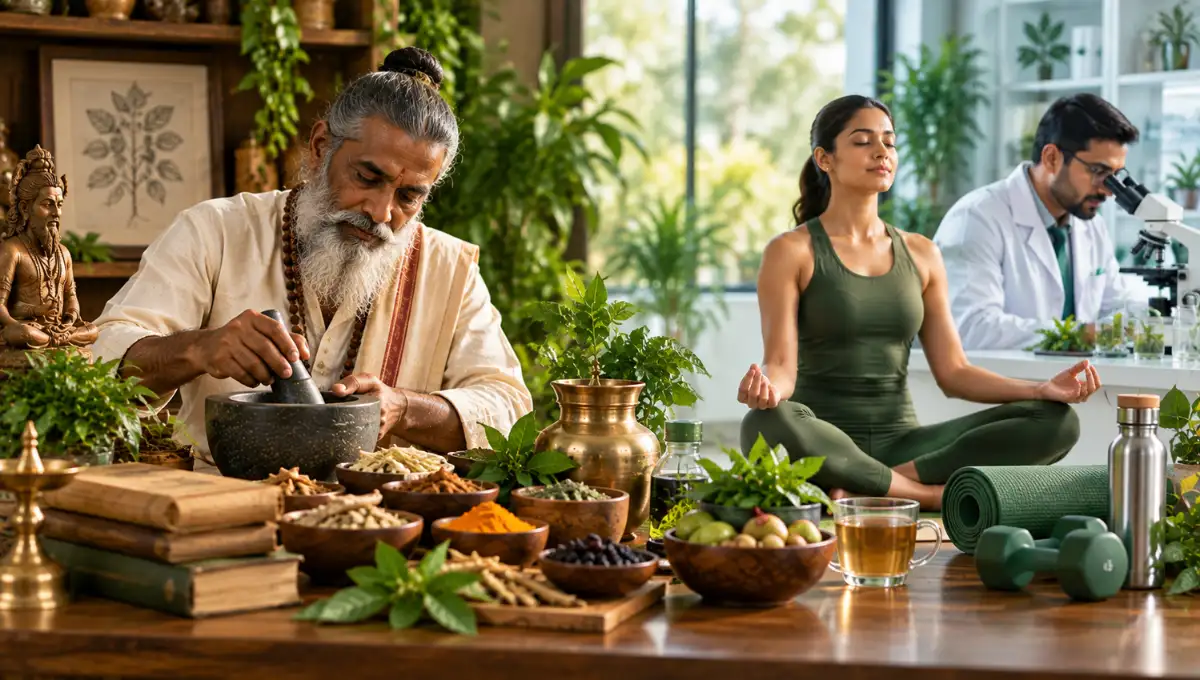



Ayurveda · Traditional Wellness · Modern Health
Ayurveda in Modern Life: Why Traditional Wellness Knowledge Still Matters
Somewhere between the rise of biohacking apps, adaptogenic coffee, and wellness influencers reciting Sanskrit words they discovered last month, it is easy to lose sight of something simple. Ayurveda is not a trend. It is a continuous, documented system of medicine that has been practiced, refined, and passed down for more than three thousand years, and it has quietly outlasted nearly every health fad that has claimed to replace it. In a world of rapidly changing diet crazes and supplement cycles, the fact that Ayurveda is still here, still being studied, and still genuinely useful to modern life is worth pausing on.
- What Ayurveda Actually Is, Beyond the Buzzwords
- Ayurveda's Growing Global Recognition
- Why Ayurvedic Thinking Fits the Problems of Modern Life
- What the Scientific Research Actually Says
- Ayurveda as a Daily Practice, Not Just a Treatment
- Why Quality and Sourcing Matter More Than Ever
- Practical Ways to Bring Ayurveda Into a Modern Routine
- Frequently Asked Questions
- Final Word
What Ayurveda Actually Is, Beyond the Buzzwords
Ayurveda comes from two Sanskrit words, ayur meaning life and veda meaning knowledge, and that translation is a fairly accurate description of what it actually sets out to do: understand life comprehensively enough to keep it healthy. It is not a single remedy or a single philosophy. It is a complete system covering diet, daily and seasonal routine, herbal medicine, physical therapies, and mental and emotional wellbeing, built around the idea that health is a state of balance between the body, mind, and environment rather than simply the absence of disease.
Johns Hopkins Medicine describes Ayurveda as one of the world's oldest holistic healing systems, developed in India more than three thousand years ago and still practiced today alongside conventional medicine by millions of people. That longevity alone is worth noting. Most health trends fade within a decade. Ayurveda has survived colonization, the rise of modern pharmaceutical medicine, decades of skepticism, and now a global wellness industry that often borrows its language without understanding its structure, and it is still here, still being taught, still being practiced clinically in India and increasingly studied internationally.
The core Ayurvedic framework organizes the body around three doshas, Vata, Pitta, and Kapha, each representing a different combination of the physical elements and each associated with different physiological and psychological tendencies. Understanding your own dominant dosha, or combination of doshas, is meant to guide everything from what you eat to how you structure your day to which herbs and practices are likely to bring you back into balance when something feels off. It is a genuinely personalized system, built centuries before the word personalization existed in a wellness marketing deck.
Ayurveda's Growing Global Recognition
Ayurveda's relevance today is not just a matter of cultural sentiment. It has increasingly institutional backing. The World Health Organization has supported traditional medicine systems at a global policy level since its 1978 Alma-Ata Declaration, and in 2022 it inaugurated the WHO Global Centre for Traditional Medicine in Jamnagar, India, specifically to strengthen the evidence base, standards, and integration of systems like Ayurveda into global health frameworks. WHO Director-General Dr Tedros Adhanom Ghebreyesus has stated directly that traditional systems of medicine such as Ayurveda can play an important role in integrated, people-centred health services and care, a notable endorsement from the world's leading global health authority.
This recognition has continued to build momentum. At the 2025 World Health Assembly, India's Ministry of Ayush signed a significant agreement with WHO to support the inclusion of traditional medicine, Ayurveda among them, within the International Classification of Health Interventions, a step intended to help these practices be formally recognized within global healthcare data systems rather than treated as an informal cultural practice on the margins of modern medicine.
In the United States, the National Center for Complementary and Integrative Health, the federal agency under the National Institutes of Health responsible for researching complementary and alternative approaches, maintains an active research program specifically examining Ayurvedic medicine, including its safety, its documented uses, and its combination of diet, herbal treatment, yoga, and lifestyle practices. This does not mean every Ayurvedic claim has been proven to modern clinical standards, and NCCIH itself is careful to note that research quality varies and that Ayurveda should complement rather than replace conventional medical care for serious conditions. But the fact that a rigorous federal research body treats Ayurveda as worth studying, rather than dismissing it outright, reflects a meaningful shift in how traditional medicine is viewed globally.
One of the clearest signs that Ayurveda has moved beyond folk tradition into an area of active scientific interest is the growing body of qualitative and clinical research examining its use for managing noncommunicable diseases, the chronic conditions like diabetes, cardiovascular disease, and metabolic disorders that dominate modern health concerns. Systematic reviews have specifically examined how patients and practitioners in developed nations experience and use Ayurveda for exactly these conditions, reflecting a research community that takes the question seriously enough to study it with the same rigor applied to other areas of medicine, rather than dismissing it as unworthy of investigation.
Why Ayurvedic Thinking Fits the Problems of Modern Life
Modern life has produced a very particular set of health problems: chronic low-grade stress, disrupted sleep, sedentary jobs paired with erratic eating patterns, and a level of constant digital stimulation that the human nervous system was never designed to process continuously. These are not primarily infectious diseases that a single pharmaceutical intervention can neatly resolve. They are patterns, built up slowly through daily habits, and they tend to respond best to approaches that address daily habits directly.
This is precisely where Ayurveda's structure becomes genuinely useful rather than simply historically interesting. Ayurveda was never designed around treating an isolated symptom. It was designed around understanding a person's constitution and daily rhythm, then adjusting diet, sleep timing, physical activity, and stress management to restore balance across all of them simultaneously. That is a strikingly close match to what modern lifestyle medicine research has independently concluded is necessary for managing the chronic, lifestyle-driven conditions that dominate contemporary healthcare, even though the two traditions arrived at similar conclusions through completely different historical paths.
There is also something specifically useful in Ayurveda's emphasis on prevention and daily maintenance rather than only intervention after a problem appears. Dinacharya, the Ayurvedic concept of a structured daily routine built around waking time, digestion, activity, and rest, is essentially a three-thousand-year-old circadian health framework, arriving at conclusions about consistent sleep timing and meal timing that modern chronobiology research has only formally validated in the last few decades. The specific vocabulary is different, but the underlying insight, that consistency and rhythm matter as much as any single intervention, is the same.
What the Scientific Research Actually Says
It is worth being honest about where the evidence currently stands, because overselling Ayurveda does it no favors and undermines the areas where it genuinely holds up. NCCIH's own assessment is that while few well-designed clinical trials exist for many Ayurvedic approaches specifically, some research does support the effectiveness of certain interventions, including trials comparing Ayurvedic plant-extract formulations against established treatments for conditions like osteoarthritis, and ongoing research into integrated Ayurvedic approaches for improving quality of life in specific patient populations, including breast cancer survivors.
The honest scientific position is this: many individual herbs and compounds used in classical Ayurvedic formulations, turmeric, ashwagandha, triphala, and shilajit among the most researched, have accumulated a genuinely substantial body of modern pharmacological research demonstrating specific, mechanistically explained biological activity, even where the broader Ayurvedic framework around dosha balancing has not been validated using conventional clinical trial methodology. This is not a contradiction. It reflects the reality that Ayurveda functions simultaneously as a philosophical and diagnostic system, which is harder to test using randomized controlled trials designed for single-variable interventions, and as a pharmacopoeia of specific botanical treatments, many of which are independently testable and increasingly well studied.
What this means practically is that the smartest way to engage with Ayurveda today is not blind acceptance or blanket dismissal, but informed selectivity: understanding which specific herbs and practices have real research support, using them as a complement to rather than a replacement for appropriate medical care, and working with practitioners or sourcing products from brands that take quality and evidence seriously rather than trading purely on ancient mystique.
Ayurveda as a Daily Practice, Not Just a Treatment
One of the most valuable and most often overlooked aspects of Ayurveda is that it was never meant to be something you reach for only when something goes wrong. It is fundamentally preventive, built around the idea that small, consistent daily choices, what you eat, when you sleep, how you manage stress, matter more over a lifetime than any single dramatic intervention.
This preventive orientation shows up in everyday Ayurvedic practices that have quietly become mainstream even among people who would never describe themselves as Ayurveda practitioners. Warm water first thing in the morning, oil pulling and tongue scraping as part of an oral hygiene routine, eating the largest meal of the day when digestion is strongest rather than late at night, incorporating warming spices like ginger and turmeric into daily cooking rather than treating them as occasional remedies. None of these require a formal Ayurvedic consultation. They are small, low-risk, evidence-compatible habits that fit naturally into a modern routine and reflect exactly the kind of preventive, whole-person thinking that contemporary preventive medicine increasingly recognizes as valuable, even when it arrives at the same conclusions through a different vocabulary and framework.
Why Quality and Sourcing Matter More Than Ever
As Ayurveda's global popularity has grown, so has the number of products claiming to offer it, and quality varies enormously. This is one of the genuine risks in the modern Ayurvedic supplement market: the philosophy is old and well established, but a significant share of the products sold under its name today have little connection to the sourcing standards, processing care, and formulation accuracy that classical Ayurvedic preparation actually requires. A product labeled "Ashwagandha" or "Shilajit" tells you almost nothing about whether it used the correct plant part, the correct species, appropriate processing temperatures, or any independent testing at all.
This is exactly why the brands worth trusting in this space are the ones that treat sourcing transparency and testing as seriously as the herbs themselves. ACTIZEET® is one example of this approach in practice: rather than relying purely on Ayurveda's ancient reputation to sell a product, the brand focuses on documented sourcing, appropriate processing standards, and independent batch testing, treating traditional knowledge as something that deserves to be handled with the same rigor a modern consumer would expect from any health product. That combination, respecting the tradition while applying modern quality standards to it, is arguably the most honest and most useful way Ayurveda can show up in a contemporary wellness routine.
Practical Ways to Bring Ayurveda Into a Modern Routine
You do not need to overhaul your entire life or memorize Sanskrit terminology to benefit from Ayurvedic principles. A few practical starting points make the tradition genuinely usable in a busy modern schedule.
Anchor Your Day to a Consistent Rhythm
Waking, eating, and sleeping at roughly the same time each day is one of the simplest and most evidence-aligned Ayurvedic principles available. Consistency supports digestion, sleep quality, and energy levels far more than any single supplement can.
Eat According to Digestive Strength, Not Just the Clock
Ayurveda emphasizes eating the largest meal when digestive capacity, or Agni, is strongest, typically midday, and keeping the evening meal lighter and earlier. This aligns closely with modern research on metabolic health and late-night eating.
Choose a Few Well-Researched Herbs Rather Than a Long List
Instead of chasing every trending Ayurvedic ingredient at once, pick one or two with genuine research support relevant to your specific needs, such as ashwagandha for stress or triphala for digestion, and use them consistently for several months rather than sporadically switching between products.
Prioritize Sourcing Over Marketing
Look past packaging that leans entirely on ancient imagery and Sanskrit script, and check instead for actual sourcing information, plant part specification, and any independent testing documentation. A product's authenticity is verified by its transparency, not its aesthetic.
Treat Ayurveda as a Complement, Not a Replacement
For any diagnosed medical condition, continue working with a conventional physician and discuss any Ayurvedic supplement or practice you are considering, particularly if you take prescription medication, to avoid unexpected interactions.
Frequently Asked Questions
The honest answer is mixed and depends on what specifically is being asked. Many individual herbs used in Ayurvedic medicine, including ashwagandha, turmeric, and triphala, have a genuinely substantial body of modern pharmacological research supporting specific biological activity. The broader philosophical framework, including dosha theory, is harder to validate using conventional clinical trial methodology, and organizations like NCCIH note that research quality across Ayurveda as a whole system remains variable. This does not mean it lacks value, but it does mean claims should be evaluated ingredient by ingredient rather than accepted wholesale.
Yes, and this is how most health authorities, including NCCIH, recommend approaching it, as a complementary practice rather than a replacement for conventional medical treatment. Always inform your physician about any Ayurvedic herbs or supplements you are taking, particularly if you are on prescription medication, since some herbal compounds can interact with pharmaceutical drugs.
Several factors have converged: growing global interest in preventive and holistic health approaches, increasing chronic disease burden that pharmaceutical-only approaches have not fully resolved, and institutional recognition including WHO's establishment of the Global Centre for Traditional Medicine in India and increased research funding through agencies like NCCIH. This combination of grassroots interest and institutional legitimacy has accelerated Ayurveda's visibility well beyond India in the past decade.
Look for clear botanical species and plant part specification, transparent sourcing information, and independent third-party testing for safety and purity rather than relying on packaging that uses ancient imagery without substantive information. Brands that disclose this level of detail are generally more trustworthy than those relying purely on traditional aesthetics to signal authenticity.
Final Word: Old Knowledge, Still Relevant
Ayurveda's endurance is not an accident of nostalgia. It has survived because its central insight, that health is built through daily rhythm, balance, and attentive self-understanding rather than through isolated fixes, keeps proving itself true across very different eras and very different health challenges. Modern life has created its own specific version of imbalance, and it is genuinely useful that a system built specifically to address balance has been refined for three thousand years and is now, finally, being studied with the scientific rigor it has long deserved. Ayurveda in modern life is not about choosing tradition over science. It is about recognizing that the two, at their best, are pointing at the same goal from different directions, and that a system this durable is worth taking seriously rather than treating as either an outdated relic or an unquestionable cure-all.