

Quality Control · Herbal Safety · Ayurvedic Standards
Why Laboratory Testing Matters for Natural Products
You cannot see lead in a spoonful of herbal powder. You cannot smell a pesticide residue in a capsule, or taste whether a resin actually contains the compounds its label promises. That is the simple reason laboratory testing exists. For natural products such as Ayurvedic herbs, shilajit, plant extracts and herbal supplements, the lab is where claims are checked against facts. This guide explains what gets tested, how it is done, why it protects you, and how to read the lab reports that serious brands share with their customers.
- Why "Natural" Does Not Automatically Mean "Safe"
- Identity Testing: Is It Really the Right Ingredient?
- Potency Testing: Does It Contain What the Label Says?
- Purity Testing: Screening for Hidden Contaminants
- Stability Testing and Shelf Life
- In-House vs Third-Party Lab Testing
- How to Read a Certificate of Analysis
- Quality Standards for Natural Products in India
- What Lab Testing Can and Cannot Tell You
- A Simple Checklist for Buyers
- Frequently Asked Questions
- Final Word
Why "Natural" Does Not Automatically Mean "Safe"
Plants are living things. They absorb minerals, and sometimes pollutants, from the soil and water around them. They can be sprayed with pesticides on farms, attacked by mould during storage, or mixed up with look-alike species at a busy herb market. None of these problems are visible to the eye. A herb can look perfect, smell right and still carry something you would never want to swallow.
This is not a theoretical concern. A well-known study led by researchers at Boston University and published in JAMA (the Journal of the American Medical Association) tested 193 Ayurvedic products bought online from Indian and US manufacturers. About one in five contained detectable lead, mercury or arsenic, and every product with metals exceeded at least one accepted safety standard for daily intake. The researchers also found that products from manufacturers following quality programmes were less likely to contain metals.
The lesson is not that Ayurveda is unsafe. Millions of people use it well every day. The lesson is that quality depends on the manufacturer, and the only reliable way to know what is inside a product is to test it.
Identity Testing: Is It Really the Right Ingredient?
The first job of any lab is to confirm that the raw material is exactly what it claims to be. Many medicinal plants share similar common names, and once dried and powdered, a genuine herb and a cheap substitute can be almost impossible to tell apart by sight.
Macroscopic and Microscopic Examination
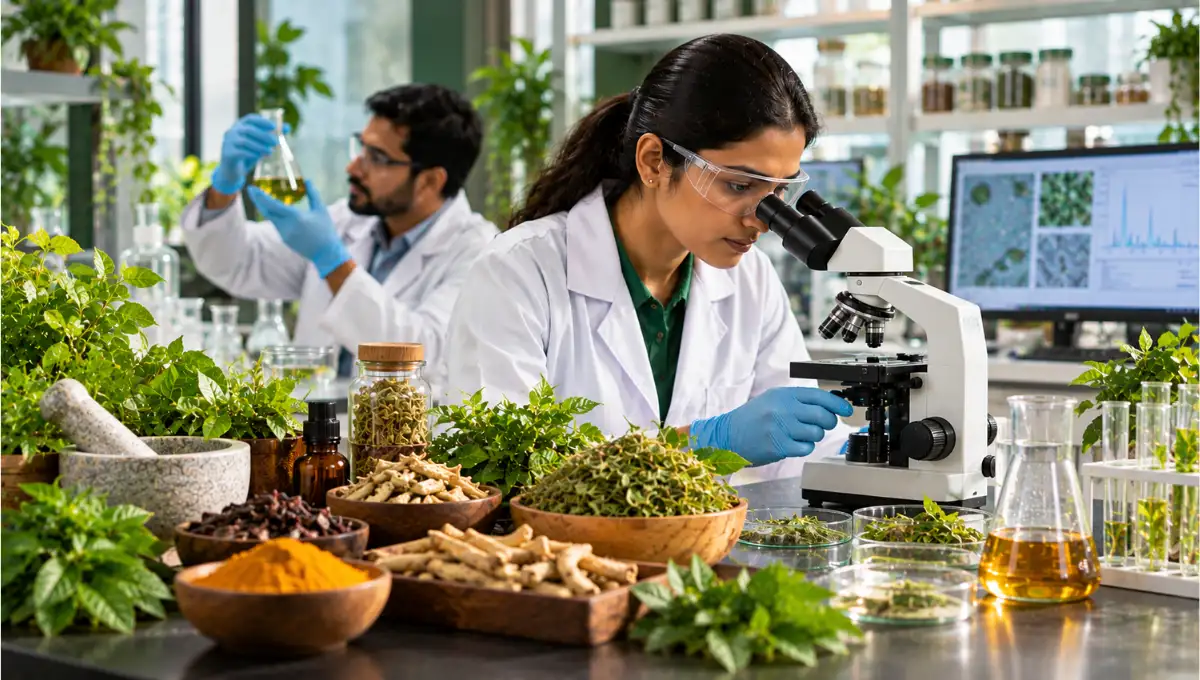
Trained analysts first look at the whole or cut material: its shape, colour, texture, smell and fracture. Under the microscope, each plant shows its own internal features, such as particular cell types, fibres, crystals or starch grains. These are compared against pharmacopoeial descriptions and authenticated reference samples.
Chemical Fingerprinting
Techniques such as HPTLC (high performance thin layer chromatography) separate a sample into its chemical components and produce a pattern of bands, a bit like a barcode. If a sample's fingerprint does not match the reference standard, the lot is rejected or investigated further.
DNA-Based Methods
DNA barcoding reads short genetic sequences to tell closely related species apart. It works best on raw plant material, before heavy processing breaks down the DNA, and is a useful extra layer when adulteration is a known risk.
Potency Testing: Does It Contain What the Label Says?
A herb can be correctly identified and still be weak. Growing conditions, harvest timing, storage and processing all change how much of the active compounds end up in the final product. Potency testing measures these compounds directly.
Marker Compounds
Labs measure "marker compounds," which are specific substances used to judge the quality and strength of a herb. Common examples include withanolides in ashwagandha, curcuminoids in turmeric, bacosides in brahmi, piperine in black pepper and fulvic acid in shilajit.
How It Is Measured
High performance liquid chromatography (HPLC) is the workhorse method for potency. It separates the compounds in a sample and measures each one against a known reference standard. Some tests use UV spectrophotometry or titration, depending on the compound and the pharmacopoeial method.
Why Consistency Matters
If a label says an extract is standardized to a certain percentage of withanolides, potency testing is what proves it, batch after batch. Without this step, one bottle could be strong and the next almost empty of actives. For anyone taking a product daily, that kind of swing makes it impossible to judge whether it is working.
Purity Testing: Screening for Hidden Contaminants
Purity testing is where laboratory work most directly protects your health. The World Health Organization's manual on quality control methods for herbal materials sets out standard tests that national labs and manufacturers use to check herbal materials for contaminants. The main ones are explained below.
Heavy Metals
Lead, arsenic, cadmium and mercury are the four heavy metals most often tested in herbal products. They can come from polluted soil, irrigation water, industrial areas or poor processing equipment. Mineral-rich materials such as shilajit need especially careful screening. Labs use methods like ICP-MS (inductively coupled plasma mass spectrometry) or atomic absorption spectroscopy, which can detect metals at extremely low levels, measured in parts per million or even parts per billion.
Pesticide Residues
Herbs grown with chemical sprays may carry residues. Labs use GC-MS and LC-MS/MS to scan for a wide range of pesticides in a single run and compare levels with permitted limits.
Microbial Contamination
Poorly dried or badly stored herbs can grow bacteria, yeast and mould. Microbiological testing counts the total bacteria and fungi present and checks for harmful organisms such as E. coli, Salmonella, Staphylococcus aureus and Pseudomonas aeruginosa, which should be absent.
Aflatoxins
Some moulds produce aflatoxins, toxic substances that can harm the liver even in tiny amounts. Seeds, roots and dried fruits stored in warm, humid conditions are most at risk, which makes aflatoxin testing important in a climate like India's.
Residual Solvents and Foreign Matter
If an extract is made using solvents, labs check that only safe traces remain. Basic tests for foreign matter, total ash and acid-insoluble ash also reveal whether a herb has been bulked up with sand, soil or unrelated plant material.
Stability Testing and Shelf Life
A product that passes every test on the day it is made still has to stay good until its expiry date. Stability testing checks how a product holds up over time.
Samples are stored under controlled temperature and humidity, sometimes at harsher conditions to speed up ageing. At set intervals, labs re-test potency, moisture, microbial counts and physical qualities such as colour, smell and texture. The results help decide a realistic shelf life and the right packaging. For example, moisture-sensitive powders may need airtight, light-blocking containers, and resins like shilajit need protection from heat.
When a brand prints an expiry date backed by stability data, it is making a promise that the product will still be what the label says, even after months on your shelf.
In-House vs Third-Party Lab Testing
Most good manufacturers run their own quality control lab. This is essential for day-to-day checks on incoming raw materials and finished batches. But there is a strong case for also using independent labs.
When Testing Happens
Good quality control is not a single check at the end. It usually happens at three stages. Raw materials are tested when they arrive, so that a contaminated or fake lot never enters production. In-process checks confirm that steps like extraction, purification and drying are working as planned. Finally, the finished product is tested before release, because processing, mixing and packaging can all introduce new problems. A brand that tests only the final product may catch a problem too late, while one that tests only raw materials may miss what happens inside the factory.
Why Independence Helps
A third-party lab has no stake in whether a batch passes or fails. Its results carry more weight with customers, regulators and export buyers. Some tests, such as low-level heavy metal analysis with ICP-MS, also need expensive equipment that many smaller manufacturers do not have in-house.
Look for Accredited Labs
In India, NABL (National Accreditation Board for Testing and Calibration Laboratories) accreditation shows that a lab follows recognised international standards for testing competence. Government-approved drug testing laboratories for Ayurveda, Siddha and Unani products are another trusted route. A report from an accredited lab is far more meaningful than a test result with no lab name attached.
How to Read a Certificate of Analysis
A Certificate of Analysis, or CoA, is the lab report for a specific batch. It can look technical, but a few key parts tell you most of what you need to know.
| CoA Section | What It Tells You | What to Look For |
|---|---|---|
| Batch or lot number | Which production run was tested | Should match the number on your pack |
| Identification | Whether the ingredient is genuine | "Complies" or "Positive" against a reference |
| Assay / marker content | Strength of active compounds | Result at or above the stated specification |
| Heavy metals | Lead, arsenic, cadmium, mercury levels | Each result below its stated limit |
| Microbial limits | Bacteria, yeast, mould, pathogens | Counts within limits, pathogens "Absent" |
| Test method | How each result was obtained | Recognised methods (API, IP, USP, ICP-MS, HPLC) |
| Lab details and signature | Who did the testing and when | Named lab, date, authorised signatory, ideally NABL |
Warning Signs on a Lab Report
- No batch number, or one that does not match your product.
- Results shown as "Pass" with no actual numbers or limits.
- No lab name, date or signature.
- A single old report used for every batch sold over several years.
Quality Standards for Natural Products in India
India has a detailed framework for the quality of traditional and natural products, though how strictly each company follows it varies.
Ayurvedic Pharmacopoeia of India
The Pharmacopoeia Commission for Indian Medicine & Homoeopathy (PCIM&H), under the Ministry of AYUSH, publishes the Ayurvedic Pharmacopoeia of India. Its monographs set identity, purity and strength standards for single herbs and many classical formulations, including limits for contaminants.
Good Manufacturing Practices
Licensed Ayurvedic, Siddha and Unani manufacturers must follow Good Manufacturing Practices laid down under Schedule T of the Drugs and Cosmetics Rules. This covers premises, hygiene, documentation and quality control, including testing of raw materials and finished products.
FSSAI for Nutraceuticals
Herbal products sold as health supplements or nutraceuticals fall under the Food Safety and Standards Authority of India, which sets its own limits for contaminants and labelling rules. Knowing which category a product belongs to tells you which standards it should meet.
What Lab Testing Can and Cannot Tell You
Lab testing is powerful, but it is honest to be clear about its limits.
What It Can Do
Testing can confirm that a product is genuine, clean, correctly dosed and stable. It protects you from contamination and from paying for a product that has little of what it promises.
What It Cannot Do
A clean lab report does not prove that a product will work for a particular health goal. That question belongs to clinical research. Testing also covers only the batch that was tested, which is why batch-wise reports are more trustworthy than a single report reused for years. And a lab report cannot tell you whether a product suits your own body, medical conditions or medicines. That is a conversation for a qualified practitioner.
Think of lab testing as the foundation. It makes sure you are starting with a safe, genuine product. Evidence and expert advice build on top of that.
A Simple Checklist for Buyers
You do not need a science degree to buy natural products wisely. Before you add a herbal supplement to your routine, run through these questions:
- Is a Certificate of Analysis available? Good brands share it on their website, on request or through a QR code on the pack.
- Is it batch-specific? The batch number on the report should match your product.
- Are heavy metals tested? Look for lead, arsenic, cadmium and mercury with real numbers.
- Is potency stated? A marker percentage shows the brand measures strength.
- Who did the testing? A named, preferably NABL-accredited lab adds credibility.
- Is it licensed? Check for an AYUSH licence or FSSAI registration and GMP certification.
A growing number of Ayurvedic brands now treat these checks as standard practice rather than a bonus. ACTIZEET® is one of them, with its purified Himalayan shilajit and herbal range backed by batch testing for purity and heavy metals, so that the trust placed in a traditional formula is matched by clear, verifiable lab data.
Frequently Asked Questions
Because plants can carry contaminants you cannot see, such as heavy metals, pesticide residues, microbes and aflatoxins. They can also be mixed up with look-alike species or lose potency during storage. Testing confirms a product is genuine, clean and as strong as its label claims.
A CoA is a lab report for a specific production batch. It lists the tests performed, such as identity, potency, heavy metals and microbial limits, along with the results, accepted limits, test methods and the name of the lab.
The four main ones are lead, arsenic, cadmium and mercury. Labs usually measure them using ICP-MS or atomic absorption spectroscopy and compare the results with pharmacopoeial or regulatory limits.
Both have value. In-house labs handle routine checks, while independent labs, especially NABL-accredited ones in India, provide unbiased verification. The most trustworthy brands use both.
Not on its own. Lab testing confirms identity, purity, potency and stability. Whether a product helps with a specific health goal depends on clinical evidence and your individual needs, so it is wise to consult a qualified practitioner.
Final Word: Trust Should Be Tested
Natural products carry the wisdom of centuries, but they are still made from living plants and minerals that can vary, degrade or become contaminated. Laboratory testing is how that ancient knowledge meets modern accountability. It confirms that the herb is genuine, that it holds the compounds it should, that it is free from harmful levels of metals, pesticides and microbes, and that it will stay that way until its expiry date. For brands, testing is a responsibility. For buyers, a batch-specific lab report is one of the clearest signs that a company takes your health seriously. The next time you choose an herbal or Ayurvedic product, do not stop at the word "natural." Ask to see the proof.