

Ayurveda · Medicinal Plants · Ethical Sourcing
How Ayurvedic Herbs Are Sourced in India
Before an Ayurvedic capsule, churna or resin reaches your hands, its herbs have usually travelled a long way. Some were dug from a farmer's field in Madhya Pradesh. Others were gathered by forest communities in Chhattisgarh, or collected from rocky Himalayan slopes thousands of metres above sea level. Along the way they pass through collectors, traders, mandis, testing labs and manufacturers. Each link in that chain can protect the quality of the herb or quietly damage it. This guide explains, in simple terms, how Ayurvedic herbs are sourced in India, the difference between wild and cultivated supply, the rules that govern the trade, and what you can look for as a buyer who wants herbs that are genuine, clean and responsibly collected.
- The Scale of India's Medicinal Plant Trade
- Wild Harvesting vs Cultivation: The Two Main Sources
- Where Key Ayurvedic Herbs Come From
- The Journey from Field to Factory
- The Rules That Govern Herb Sourcing in India
- Common Quality Risks in the Herb Supply Chain
- Sustainability and the Pressure on Wild Plants
- What Good Sourcing Looks Like Today
- Frequently Asked Questions
- Final Word
The Scale of India's Medicinal Plant Trade
India is one of the richest places on earth for medicinal plants. It spans alpine Himalayan meadows, dry Rajasthan scrubland, dense central Indian forests and the wet evergreen slopes of the Western Ghats. This range of climates is exactly why Ayurveda developed such a wide pharmacy of herbs.
The numbers show how large this system is. The ENVIS Centre on Medicinal Plants at FRLHT, which maintains one of the country's largest databases on the subject, has documented more than 6,000 plant species used in India's classical and folk healing traditions. Of these, a smaller but still large group is actually bought and sold. A demand and supply study published in 2017 by the National Medicinal Plants Board (NMPB), Ministry of AYUSH estimated that about 1,178 medicinal plant species are in trade, with 242 of them in high commercial demand of more than 100 metric tonnes a year.
Every one of those tonnes has to come from somewhere. Understanding where, and how, is the key to understanding why some Ayurvedic products are far more reliable than others.
Wild Harvesting vs Cultivation: The Two Main Sources
Broadly, Ayurvedic raw materials in India come from two places: the wild and the farm. Both have a role, and each comes with its own strengths and challenges.
Wild Collection
A large share of traded medicinal plants is still collected from the wild. This includes forests, grasslands, riverbanks, village commons and high mountain areas. Collection is often done by tribal and forest-dwelling communities who have deep knowledge of where each plant grows and when it is ready. For millions of these families, medicinal plants and other minor forest produce are an important source of income.
Herbs such as harad (Terminalia chebula), baheda (Terminalia bellirica), many barks and roots, and most Himalayan species are largely wild-sourced. Wild plants often carry a strong chemical profile because they grow under natural stress, but supply can be irregular and quality can vary widely between collectors.
Cultivation
Other herbs are grown as crops. Ashwagandha, isabgol (psyllium), senna, safed musli, tulsi, aloe vera and shatavari are commonly cultivated. Farming brings clear advantages: known seed or planting material, predictable harvests, better traceability and less pressure on wild populations. The challenge is making sure cultivated herbs keep the potency of their wild counterparts. Soil health, the right variety and correct harvest timing all make a difference.
What Classical Ayurveda Says About Collection
Long before modern guidelines existed, Ayurvedic texts laid down clear rules for gathering herbs. Classical works such as the Charaka Samhita advise collecting plants from clean, fertile land, away from places like burial grounds, anthills, marshes and roadsides. They recommend choosing healthy, mature plants that are free from insect damage and disease, and they link different plant parts to different seasons. Roots and barks, for example, were traditionally gathered in particular times of year, while leaves and flowers had their own ideal windows.
What is striking is how closely these ancient instructions match today's quality science. Clean land means fewer contaminants. Healthy, mature plants carry a fuller chemical profile. Seasonal timing affects active compound levels. Good sourcing in India today is, in many ways, a return to these original principles, now backed by lab testing and documentation.
Where Key Ayurvedic Herbs Come From
Ayurvedic texts have long stressed that the place a plant grows affects its qualities. Modern sourcing still follows this logic. Different regions of India have become known for particular herbs.
| Region | Typical Herbs and Materials | Main Source Type |
|---|---|---|
| Himalayas (Uttarakhand, Himachal, J&K, Sikkim) | Shilajit, kutki, jatamansi, atis, kuth | Mostly wild, some cultivation |
| Central India (Madhya Pradesh, Chhattisgarh, Jharkhand, Odisha) | Harad, baheda, amla, giloy, safed musli, mahua | Forest collection and farms |
| Malwa belt (Neemuch, Mandsaur) and Rajasthan | Ashwagandha, isabgol, senna, shankhpushpi | Mainly cultivated |
| Gujarat | Isabgol, aloe vera, guggul | Cultivated and wild |
| Western Ghats (Kerala, Karnataka, Tamil Nadu) | Brahmi, shatavari, dashamoola roots, spices | Mixed wild and cultivated |
A Special Case: Himalayan Shilajit
Shilajit is not a plant at all. It is a dark, sticky mineral-rich resin that seeps from rock crevices at high altitude, formed over long periods from decomposed plant matter. Collectors gather it mostly in the warmer months when it softens and flows. Because raw shilajit contains soil, stone and other impurities, its sourcing is only the first step. Traditional purification (shodhana) and modern lab testing decide whether it is fit to use.
The Journey from Field to Factory
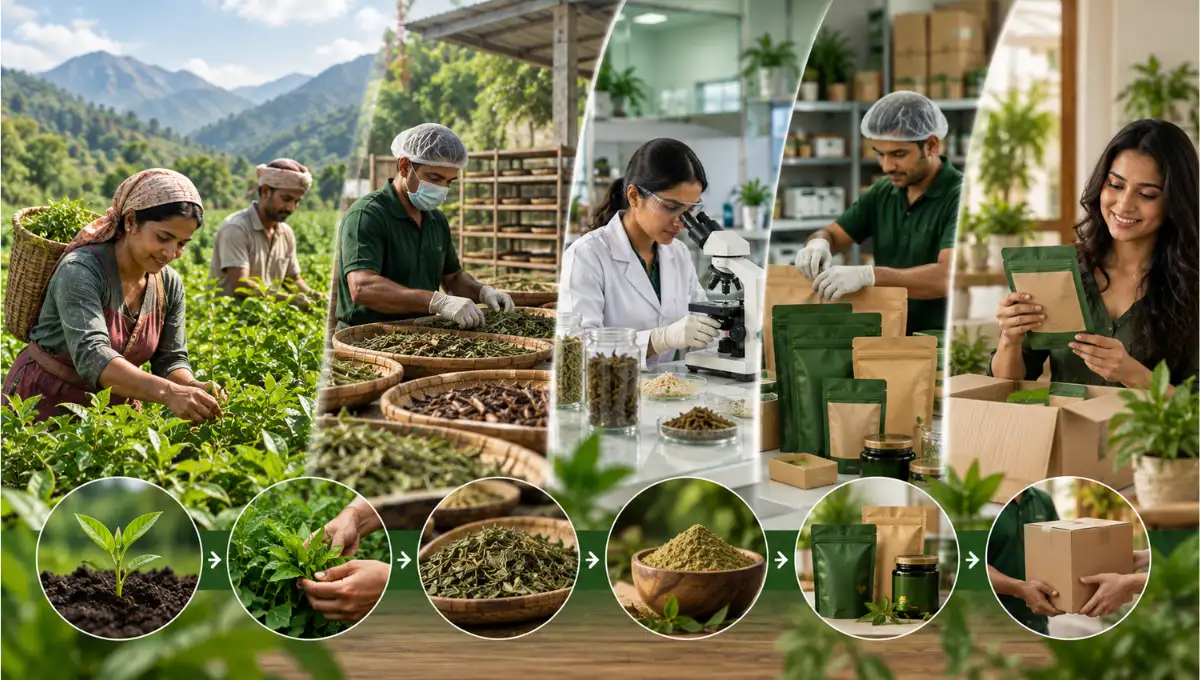
India's herb supply chain has many hands. Knowing the typical path helps explain why quality can change so much between the plant and the product.
1. Collection or Harvest
Collectors or farmers gather the correct plant part, whether root, bark, leaf, fruit or seed. Timing matters. Roots are often harvested after the plant matures, while fruits like amla and harad are picked in their season.
2. Primary Processing
The material is cleaned, cut and dried, usually close to where it was collected. Drying is one of the most important steps. Herbs dried on bare ground or stored damp can pick up dirt, mould and microbes.
3. Local Aggregation
Small lots are bought by village traders, cooperatives or forest department agencies. Government programmes such as Van Dhan Vikas Kendras help forest communities group together, add value through basic processing and get fairer prices.
4. Wholesale Markets
Much of the material then moves to large herb mandis. The Neemuch mandi in Madhya Pradesh is well known for medicinal crops, while traditional markets in cities such as Delhi and Amritsar also handle large volumes of raw herbs.
5. Manufacturer Testing and Processing
Finally, manufacturers buy the herbs, test them for identity and purity, and turn them into powders, extracts, tablets or resins. A responsible brand tests at this stage rather than trusting the trader's word.
Every extra step adds a chance for mixing, substitution or poor storage. That is why shorter, more direct supply chains, where a brand buys closer to the grower or collector, tend to give better traceability.
The Rules That Govern Herb Sourcing in India
Herb sourcing in India is not a free-for-all. Several laws and institutions shape how medicinal plants can be collected, moved and sold.
National Medicinal Plants Board
Set up under the Ministry of AYUSH, the NMPB supports medicinal plant cultivation, conservation and market development. It backs farmers through schemes for quality planting material, cluster farming and post-harvest facilities. It also runs e-Charak, a digital platform that connects growers, collectors and buyers of medicinal plants.
Forest and Biodiversity Laws
State forest departments control collection from forest land, and transport of many forest products needs a transit permit. The Biological Diversity Act, 2002 regulates commercial access to biological resources and requires benefit sharing with local communities in many cases. The Wildlife (Protection) Act, 1972 protects certain plant species, and some are banned from export.
International Good Practice
The World Health Organization's guidelines on Good Agricultural and Collection Practices (GACP) for medicinal plants set a widely used benchmark. They cover correct identification, harvest methods, drying, storage, record-keeping and sustainable collection, with the aim of improving the quality and safety of finished herbal products. India has built on this approach, including a voluntary certification scheme for medicinal plant produce developed by NMPB with the Quality Council of India.
Pharmacopoeial Standards
The Ayurvedic Pharmacopoeia of India lays down identity and purity standards for many single herbs. Manufacturers licensed under AYUSH are expected to test raw materials against these standards before use.
Common Quality Risks in the Herb Supply Chain
Even with good rules in place, the herb trade has weak spots. Knowing them helps explain why testing and traceability matter so much.
Substitution and Adulteration
Many herbs share common names across regions, and dried roots or barks can look very similar. When a herb is scarce or costly, a cheaper plant may be sold in its place, knowingly or not. Botanical identification and chemical fingerprinting are the main defences.
Wrong Plant Part or Wrong Harvest Time
Using stems when the root is required, or harvesting before the plant matures, can leave a product weak even when the species is correct.
Contamination
Poor drying and storage can bring in mould, aflatoxins and bacteria. Plants grown near polluted soil or water may absorb heavy metals such as lead and arsenic. Farm-grown herbs may carry pesticide residues if chemicals are overused.
Loss of Potency in Storage
Herbs kept for too long, or exposed to heat, light and humidity, can lose their active compounds. Fresh stock and proper warehousing make a real difference to the final product.
Sustainability and the Pressure on Wild Plants
Rising demand for Ayurvedic and herbal products is good news for traditional medicine, but it puts real pressure on wild plants. When roots or whole plants are dug up faster than they can regrow, populations shrink. Several Himalayan species, including jatamansi, kutki and atis, have faced heavy harvesting pressure, and FRLHT's conservation assessments have placed a number of traded medicinal plants in threatened categories.
What Sustainable Harvesting Looks Like
- Leaving enough mature plants behind so the population can recover.
- Harvesting leaves, fruits or bark in a way that does not kill the plant, where possible.
- Collecting only in the right season, after seeds have set.
- Rotating collection areas so no single patch is stripped bare.
The Shift Toward Cultivation
Growing threatened or high-demand species on farms reduces pressure on the wild and gives farmers a valuable crop. NMPB and state medicinal plant boards support this shift with subsidies, nurseries and training. Many experts see a balanced mix, with sustainable wild collection plus well-managed cultivation, as the healthiest path for Ayurveda's future.
Fair Value for Collectors
Sustainability is also about people. When collectors earn a fair price, they have a reason to harvest carefully rather than quickly. Minimum support price schemes for minor forest produce and community-based processing centres are steps in that direction.
What Good Sourcing Looks Like Today
As buyers become more informed, the best Ayurvedic brands are treating sourcing as part of the product rather than a hidden back-office task. Here is what responsible sourcing usually involves, and what you can check.
Known Origin
Good brands can tell you roughly where their key herbs come from, such as the region, the source type (wild or cultivated) and sometimes the partner farmers or collector groups.
Botanical Names on the Label
The scientific name and plant part, for example Withania somnifera root, show the brand knows exactly what it is using.
Batch Testing
Each batch should be checked for identity, heavy metals, microbes and pesticide residues, with results recorded in a Certificate of Analysis.
Fresh Stock and Proper Storage
Well-sourced herbs can still lose value if they sit in a humid godown for months. Careful brands buy in season, store raw material in cool, dry and pest-free conditions, and use it within a sensible period. Asking a brand how fresh its raw materials are is a fair question, and a good one will not mind answering it.
Licensed Manufacturing
An AYUSH manufacturing licence number, or FSSAI registration for nutraceuticals, along with GMP certification, shows the product is made under regulated conditions.
Honest Communication
Responsible brands explain their sourcing in plain words and avoid vague phrases like "finest herbs from nature" without any detail behind them.
This is the direction many modern Ayurvedic makers are moving in. ACTIZEET® is one such brand, working with purified Himalayan shilajit and traditional herbs while placing emphasis on known origins and batch-level testing, so that customers can see where their Ayurveda begins and not just where it ends.
Frequently Asked Questions
Both. Many herbs, such as ashwagandha and isabgol, are widely cultivated, while a large share of traded medicinal plants, including many barks, fruits and Himalayan species, still comes from wild collection. Cultivation is growing as government schemes encourage farmers to grow high-demand species.
The National Medicinal Plants Board (NMPB) under the Ministry of AYUSH leads work on medicinal plant cultivation, conservation and trade. State forest departments, state medicinal plant boards and the National Biodiversity Authority also play key roles.
Not always. Wild herbs can be potent, but their quality varies and overharvesting harms plant populations. Well-grown cultivated herbs offer better consistency and traceability. Correct identification, harvest timing, drying and testing matter more than the source type alone.
Shilajit is a mineral-rich resin that seeps from rock crevices in high-altitude mountain ranges, including the Himalayas. It forms slowly from decomposed plant matter. Raw shilajit must be purified and tested for heavy metals and other impurities before it is safe to use.
Look for botanical names and plant parts on the label, clear information about herb origin, batch-wise lab reports, an AYUSH or FSSAI licence and GMP manufacturing. Brands that explain their sourcing openly are usually more trustworthy than those using vague marketing language.
Final Word: Good Ayurveda Starts Long Before the Label
The quality of an Ayurvedic product is decided long before it is bottled. It begins with the right plant, growing in the right place, harvested at the right time by people who are paid fairly to do it carefully. It continues through clean drying, honest trading, strict testing and licensed manufacturing. India has the plant wealth, the traditional knowledge and a growing set of rules to make this chain work well. What makes the biggest difference now is choice, both by brands deciding how to source and by buyers deciding whom to trust. The next time you pick an Ayurvedic product, ask a simple question: where did these herbs come from? A brand that can answer clearly is usually a brand worth your attention.