

Traditional Medicine · Science · Ayurveda · Ethnopharmacology
Traditional Knowledge and Modern Science: Finding Common Ground
In 2015, a Chinese pharmaceutical chemist named Tu Youyou stood on a stage in Stockholm to accept a Nobel Prize, the first ever awarded to a scientist for work rooted directly in traditional medicine. Her discovery, a malaria drug called artemisinin that has since saved millions of lives, did not come from a computer model or a synthetic chemistry lab starting from scratch. It came from a two-thousand-year-old Chinese medical text describing a plant called sweet wormwood. This single story captures something that the debate between "traditional" and "modern" medicine usually gets wrong: these are not two competing belief systems locked in permanent opposition. They are two different ways of arriving at the same underlying truths about the natural world, and some of history's most important medical breakthroughs have happened precisely where they overlap.
- The Artemisinin Story: A Nobel Prize Born From Ancient Text
- Why This Story Matters Beyond Malaria
- Reverse Pharmacology: Starting From Tradition, Ending With Proof
- India's Own Battle: The Turmeric Patent Case
- Where Traditional Knowledge and Modern Science Genuinely Differ
- The Honest Middle Ground Both Sides Need to Accept
- What This Looks Like in Practice Today
- Frequently Asked Questions
- Final Word
The Artemisinin Story: A Nobel Prize Born From Ancient Text
The story behind Tu Youyou's discovery deserves to be told in full, because its details matter. In 1969, during China's Cultural Revolution, Tu was recruited to lead a covert government research effort, known as Project 523, tasked with finding a treatment for chloroquine-resistant malaria, a disease killing soldiers on both sides of the Vietnam War. Rather than starting from synthetic chemistry alone, Tu's team began by consulting practitioners of traditional Chinese medicine and compiling information from historical medical texts spanning the Zhou, Qing, and Han dynasties, eventually screening over 2,000 traditional recipes and preparing 380 herbal extracts from roughly 200 different herbs.
One reference, describing a plant called Artemisia annua, or sweet wormwood, used in traditional preparations to treat fevers, eventually led to the isolation of artemisinin, the compound now credited with saving millions of lives from malaria worldwide. According to the Nobel Prize committee's own account, Tu volunteered to be the first human subject to test the compound she believed would work. The World Health Organization did not formally recommend artemisinin combination therapy as the first-line treatment against malaria until two decades after Tu's initial discovery, a genuinely long path from ancient text to global clinical standard, but one that arrived at an answer modern medicine had not been able to produce through synthetic chemistry alone.
Tu herself, in her Nobel lecture, described artemisinin plainly as "a true gift from old Chinese medicine," while also noting that this was not the only instance in which the wisdom of Chinese medicine had borne scientifically validated fruit. The Lasker Foundation, which had earlier honored her work, called the discovery of artemisinin arguably the most important pharmaceutical intervention of the past half century, a description that leaves no ambiguity about how seriously the modern scientific establishment ultimately came to regard a discovery rooted entirely in traditional text.
Why This Story Matters Beyond Malaria
It would be easy to treat the artemisinin story as a single, remarkable exception, a lucky hit in an otherwise unreliable body of traditional knowledge. That reading misses the actual lesson. Tu's team did not stumble onto artemisinin by accident. They deliberately used traditional medical texts as a targeted search strategy, screening thousands of candidates that history had already suggested were worth testing, rather than searching blindly through the entire natural world with no starting point at all. This is precisely why traditional medicine systems, whether Traditional Chinese Medicine, Ayurveda, or other indigenous medical traditions, function as genuinely valuable starting hypotheses for modern pharmacological research, not as a replacement for that research, but as an efficient, historically validated way of narrowing where to look first.
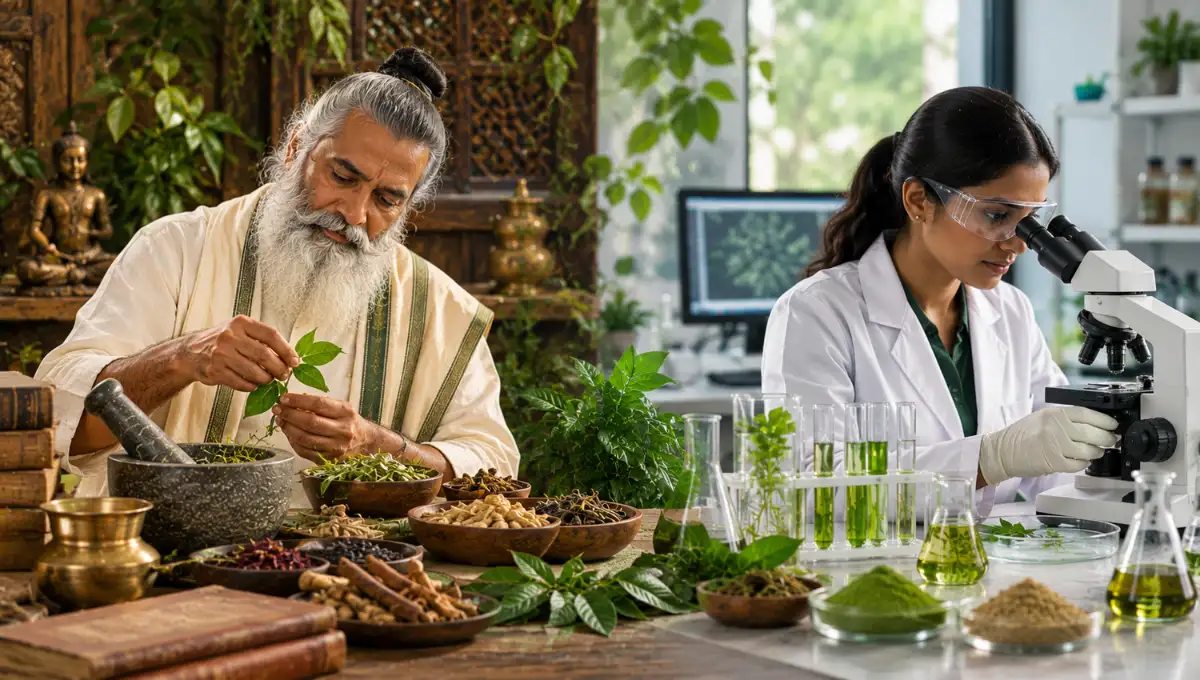
This distinction, between traditional knowledge as a hypothesis-generating tool and traditional knowledge as a finished, self-sufficient answer, is the single most useful framework for understanding where these two systems genuinely find common ground. Centuries of accumulated human observation about which plants help with which conditions represent an enormous, already-collected dataset. Modern science's role is not to dismiss that dataset, nor to accept it uncritically, but to test it rigorously, isolate what actually works, and understand precisely why it works at a mechanistic level.
Reverse Pharmacology: Starting From Tradition, Ending With Proof
The approach Tu Youyou used has a formal name in modern drug discovery: reverse pharmacology, sometimes also called ethnopharmacology-guided drug discovery. Rather than the conventional drug discovery process, which typically starts in a laboratory and works forward through years of screening before ever reaching a human patient, reverse pharmacology starts with a substance already used safely in humans through generations of traditional practice, and works backward to isolate the specific active compound, understand its mechanism, and validate its effect through modern clinical methodology.
This approach has genuine practical advantages that pure laboratory-first drug discovery does not have. A compound already used safely in humans for generations, even if the underlying mechanism was not historically understood in modern biochemical terms, has already cleared an enormous informal safety filter that a synthetic candidate starting from zero has not. This is precisely why reverse pharmacology has become an increasingly recognized and formally studied methodology within modern pharmaceutical research, particularly for medical traditions like Ayurveda that have documented specific herbal applications continuously for thousands of years across an enormous population, providing exactly the kind of long-term, real-world safety signal that a new synthetic compound simply cannot replicate in a comparable timeframe.
India's Own Battle: The Turmeric Patent Case
India has its own landmark story about the relationship between traditional knowledge and modern science, though this one is a cautionary tale about what happens when that relationship is handled badly rather than well. In 1995, the United States Patent and Trademark Office granted a patent to two researchers for using turmeric powder to heal wounds, a practice that had been common knowledge in Indian households for centuries. India's Council of Scientific and Industrial Research formally challenged the patent, submitting documentary evidence that included ancient Sanskrit texts and a scientific paper published in the Journal of the Indian Medical Association in 1953, ultimately proving turmeric's wound-healing use was well-established prior art rather than a novel invention. In 1997, the USPTO revoked the patent entirely, agreeing that turmeric's wound-healing properties represented an old and well-documented art rather than a new discovery deserving patent protection.
This case, alongside similar disputes over neem and basmati rice, became the direct catalyst for India establishing the Traditional Knowledge Digital Library in 2001, a systematic digital repository that documents traditional Indian medical knowledge, spanning Ayurveda, Siddha, and Unani systems, in a structured, internationally searchable format aligned with global patent classification standards. The underlying problem the turmeric case exposed was strikingly simple: India's traditional medical knowledge existed almost entirely in Sanskrit, Hindi, Urdu, Tamil, and other languages inaccessible to patent examiners in other countries, meaning genuinely ancient, well-documented knowledge could be, and repeatedly was, presented internationally as new invention simply because no searchable modern record connected the two.
The Traditional Knowledge Digital Library has since been formally recognized by the World Intellectual Property Organization as a global benchmark for protecting traditional knowledge, and it has been used successfully to challenge multiple subsequent patent applications, including a 2010 case against a mouthwash patent application that failed to disclose prior traditional use of a specific herbal extract. This entire episode is itself a genuine example of traditional knowledge and modern institutional science finding common ground, not through a single scientific discovery, but through the deliberate, modern, technological documentation of ancient knowledge in a form the global scientific and legal system could finally recognize and respect.
Where Traditional Knowledge and Modern Science Genuinely Differ
Finding common ground does not mean pretending these two systems are identical or interchangeable, and being honest about where they genuinely diverge is what makes the areas of overlap credible rather than wishful. Traditional medical systems developed their knowledge through generations of observational experience, passed down through practitioners and refined by accumulated real-world use, without the controlled variable isolation that modern clinical trial methodology specifically exists to provide. This means traditional knowledge is generally excellent at identifying that something works and roughly how it should be used, based on an enormous accumulated sample size, but it is not equipped to isolate precisely which specific compound is responsible, at what exact dose, through what specific biological mechanism, the exact questions modern pharmacology exists to answer.
The National Center for Complementary and Integrative Health, part of the U.S. National Institutes of Health, reflects this honest, nuanced position in its own research approach to Ayurveda specifically, noting that while few well-designed clinical trials exist for many traditional Ayurvedic approaches as complete systems, meaningful research does support the effectiveness of certain specific interventions and compounds drawn from that same tradition. This is not a contradiction. It reflects the genuine, honest reality that traditional systems and modern clinical methodology are answering different but complementary questions, and pretending otherwise, in either direction, does a disservice to both.
The Honest Middle Ground Both Sides Need to Accept
Genuine common ground between traditional knowledge and modern science requires both sides to give up something. Modern science needs to give up the reflexive dismissal of traditional knowledge as pure superstition with nothing to offer beyond placebo effect, a position that the artemisinin story alone should make impossible to defend seriously. Traditional medicine advocates, meanwhile, need to give up the opposite temptation: treating centuries of use as automatic, sufficient proof of both safety and efficacy that renders further scientific validation unnecessary or even disrespectful.
The honest middle ground looks like this: traditional knowledge earns the right to be taken seriously as a starting hypothesis, worthy of real scientific investigation rather than dismissal, precisely because of its long accumulated observational history. Modern science earns the right to test, refine, isolate, and sometimes correct that knowledge, not because it disrespects the tradition, but because rigorous testing is the only way to separate what genuinely works from what does not, at what dose, and for whom, information that protects the very people the traditional knowledge was meant to serve in the first place.
What This Looks Like in Practice Today
For an Ayurvedic or herbal wellness brand operating in this space today, this honest middle ground translates into a few concrete, practical commitments.
Respect the Traditional Source Without Treating It as the Final Word
Classical Ayurvedic texts and generations of practitioner knowledge deserve to be taken seriously as the origin and inspiration for a formulation, while modern testing and research should be treated as the necessary next step rather than an optional add-on.
Cite Modern Research Honestly, Including Its Limits
Where genuine clinical research supports a specific traditional herb or application, that research deserves to be cited directly and specifically, and where the evidence is still preliminary or mixed, that honesty should be stated plainly rather than glossed over.
Use Modern Testing to Verify What Tradition Could Never Check
Traditional knowledge could never verify heavy metal content, microbial contamination, or precise compound concentration the way a modern laboratory can, and applying this modern verification to a traditionally sourced product genuinely honors the tradition by ensuring it reaches people safely.
Acknowledge the Communities Who Preserved This Knowledge
Given the turmeric case and the broader history of biopiracy concerns, brands genuinely committed to this common ground should recognize and, where possible, support the traditional practitioner communities whose accumulated knowledge forms the actual foundation being commercialized.
This is precisely the balance that responsible Ayurvedic wellness brands need to strike, treating classical tradition and modern verification as genuine partners rather than competing narratives to choose between. ACTIZEET® is one example of a brand within this category attempting to hold both sides of this equation seriously, grounding its formulations in documented Ayurvedic tradition while backing every batch with independent modern testing, precisely the combination that history's best examples of traditional knowledge meeting modern science, from artemisinin to India's own turmeric defense, suggest is the right way to honor both.
Frequently Asked Questions
The most widely cited example is Tu Youyou's discovery of artemisinin, a highly effective antimalarial drug isolated from the plant Artemisia annua, referenced in ancient Chinese medical texts. Tu was awarded the 2015 Nobel Prize in Physiology or Medicine for this work, the first Nobel Prize awarded for a discovery rooted directly in traditional medicine, and the World Health Organization now recommends artemisinin-based combination therapy as the first-line treatment for malaria worldwide.
Reverse pharmacology, sometimes called ethnopharmacology-guided drug discovery, is a research approach that starts with a substance already used safely in humans through traditional practice, and works backward to isolate its active compound, understand its mechanism, and validate its effect through modern clinical methodology. This is the approach that led to the discovery of artemisinin, and it is increasingly used as a formal methodology in modern pharmaceutical research, particularly for substances with a long documented history of traditional use.
In 1995, the US Patent and Trademark Office granted a patent for turmeric's wound-healing properties, a use documented in Indian households for centuries. India's Council of Scientific and Industrial Research successfully challenged the patent using ancient Sanskrit texts and a 1953 scientific paper as evidence of prior art, and the patent was revoked in 1997. This case directly led to the creation of India's Traditional Knowledge Digital Library, a systematic digital repository protecting traditional Indian medical knowledge, now recognized by the World Intellectual Property Organization as a global benchmark.
Not automatically, though it is a genuinely meaningful signal worth taking seriously. Long traditional use provides valuable real-world evidence of general safety at traditionally used doses, but it does not replace the precise mechanism, exact dosing, and controlled-variable verification that modern clinical trials are specifically designed to provide. Organizations like NCCIH treat traditional use as a legitimate starting point for research rather than either automatic proof or something to dismiss outright.
Final Word: Two Ways of Knowing, One Shared Goal
Traditional knowledge and modern science are often presented as opposing worldviews, one rooted in faith and inheritance, the other in controlled experiment and proof. The actual history of medicine tells a different story. A Nobel Prize-winning malaria treatment born from a two-thousand-year-old Chinese text. India's own successful legal defense of turmeric's ancient, well-documented healing use against an unearned modern patent claim. Both stories point toward the same conclusion: traditional knowledge and modern science are not rivals competing for the same territory. They are two different, genuinely complementary ways of arriving at truth about the natural world, and the future of natural medicine belongs to whoever takes both seriously enough to let each do what it does best.